Galaxy
The Fireworks Galaxy
Also NGC 6946 · Caldwell 12
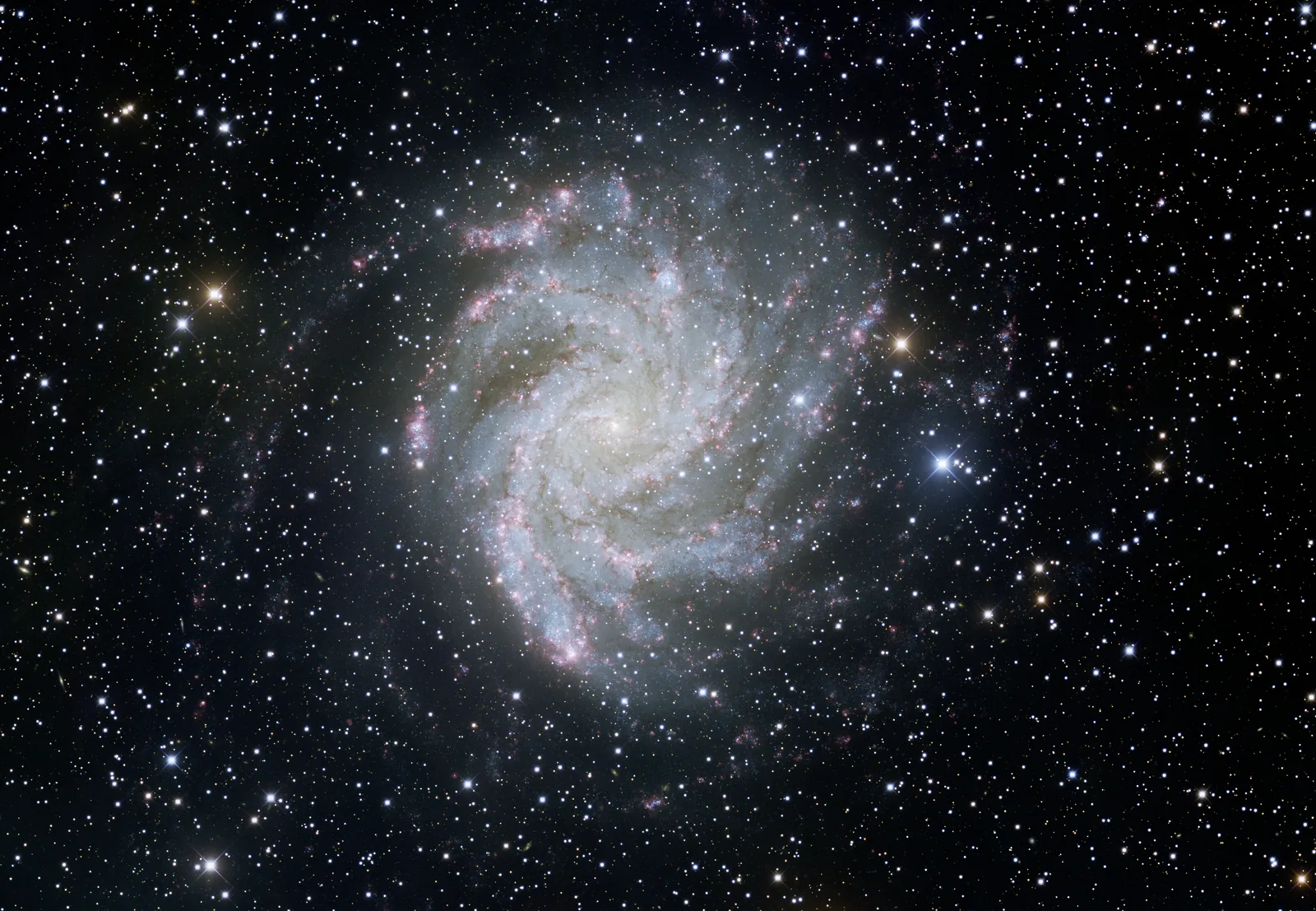
A spiral galaxy, obscured by the Milky Way's dust, that has produced an unusual number of supernovae.
Measured
- Distance
- about 18 million light-years (published estimates 18 million–25.2 million)
- Size
- about 60,000 light-years across (approximate)
- Constellation
- Cygnus
- Position (J2000)
- RA 20h 34m 52s, Dec +60.15°
How far, from the Sun
About 18 million light-years. To cross it:
- Light18 million years
- Voyager 1's speed320 billion years
- Driving at 100 km/h194 trillion years
Voyager 1 at the speed it moved outward over the year to 2026-10-25 (JPL Horizons). Driving: nonstop, never refuelling.
Facts
- Ten supernovae have been seen in it since 1917, for years the most known in any one galaxy.
- It is moving away from us at about 40 km/s (NASA/IPAC NED).
Where this comes from
- Tip-of-the-red-giant-branch value 5.52 Mpc as compiled by Lelli et al. 2016, ApJ 816, L14; up to 7.72 Mpc (Eldridge & Xiao 2019, MNRAS Letters)
- This research has made use of the SIMBAD database, CDS, Strasbourg, France (Wenger et al. 2000, A&AS 143, 9).
- This research has made use of the VizieR catalogue access tool, CDS, Strasbourg, France (DOI: 10.26093/cds/vizier).
Every catalogue Ouranos draws is credited on the credits page.