Brown dwarf
Luhman 16
Also WISE J104915.57-531906.1
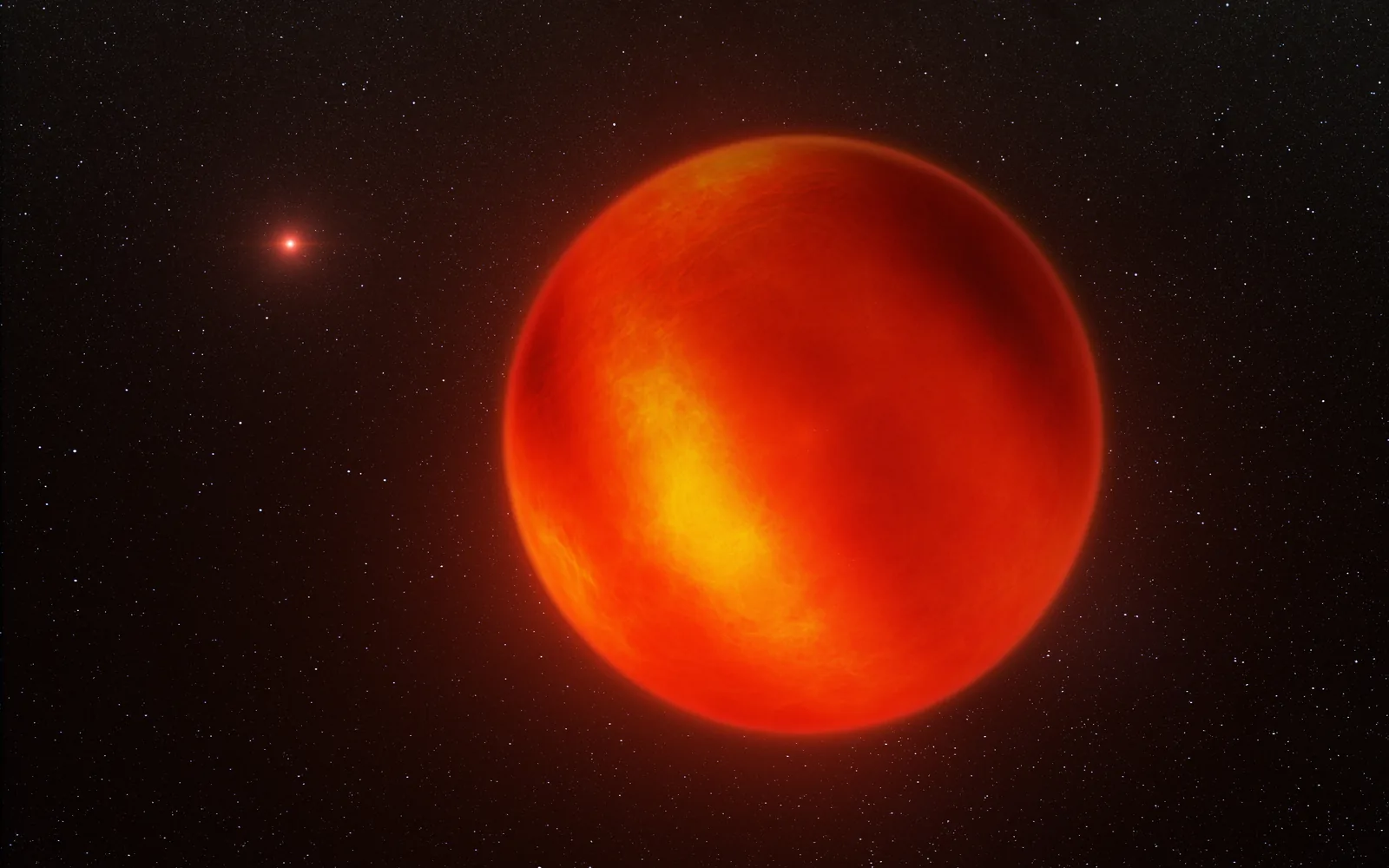
A pair of brown dwarfs orbiting each other, the nearest known brown dwarfs to the Sun.
Measured
- Distance
- 6.51 light-years
- Constellation
- Vela
- Position (J2000)
- RA 10h 49m 19s, Dec −53.32°
How far, from the Sun
6.51 light-years. To cross it:
- Light6.51 years
- Voyager 1's speed116,000 years
- Driving at 100 km/h70.3 million years
Voyager 1 at the speed it moved outward over the year to 2026-10-25 (JPL Horizons). Driving: nonstop, never refuelling.
Facts
- It is the third-closest known system to the Sun, after Alpha Centauri and Barnard's Star.
- The two have about 34 to 35 and 28 to 29 times Jupiter's mass.
- Astronomers have mapped what are probably patchy clouds on one of them.
How it was found
- Kevin Luhman discovered the pair in 2013 using WISE data.
Where this comes from
- Bedin et al. 2017, MNRAS 470, 1140, HST astrometry (absolute parallax 501.398 mas)
Every catalogue Ouranos draws is credited on the credits page.