Galaxy
The Cigar Galaxy
Also M82 · NGC 3034
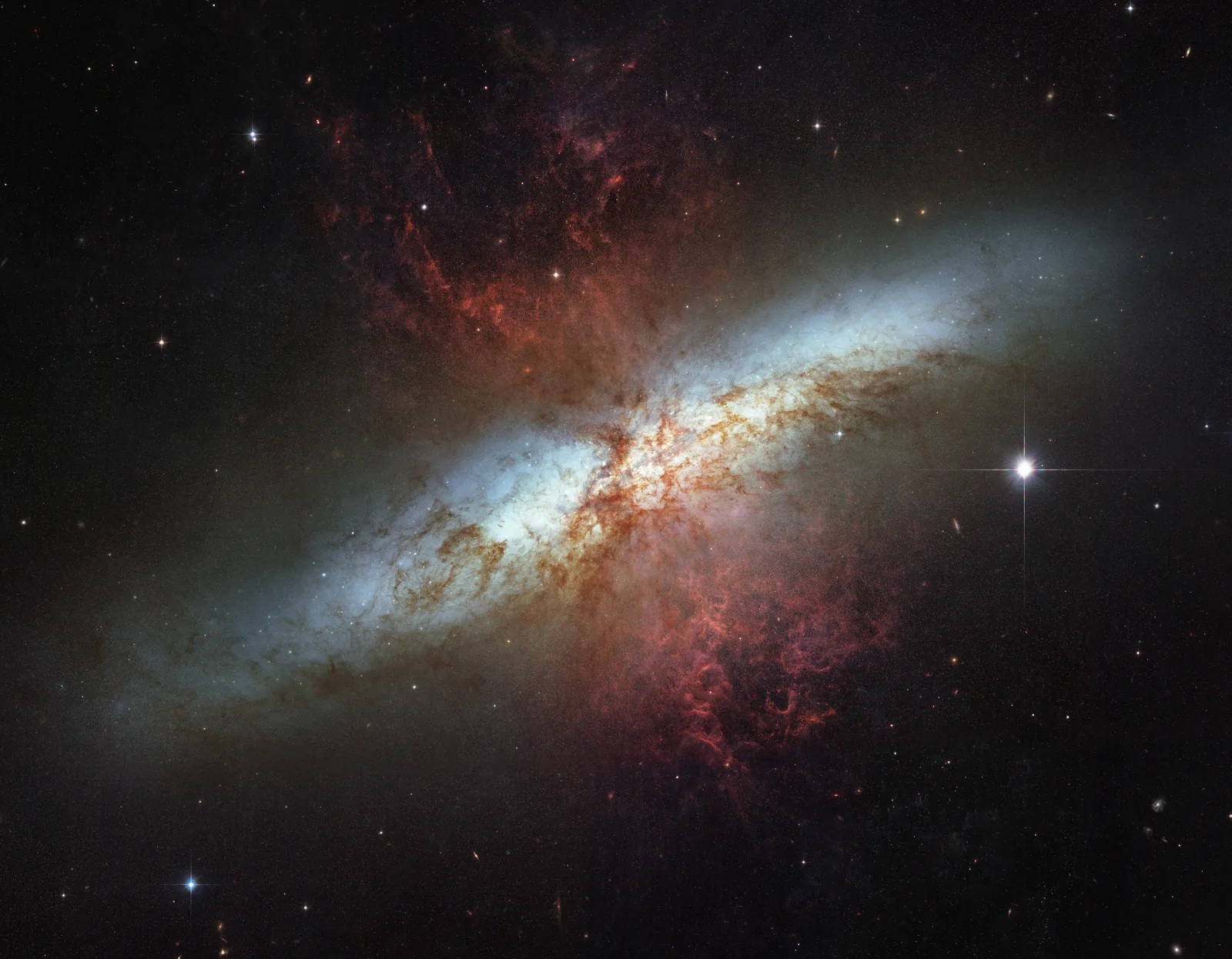
A starburst galaxy, forming stars rapidly because of gravitational interactions with its neighbour M81.
Measured
- Distance
- about 11.9 million light-years (published estimates 11.4 million–12.4 million)
- Size
- about 40,800 light-years across (approximate)
- Constellation
- Ursa Major
- Position (J2000)
- RA 9h 55m 53s, Dec +69.68°
How far, from the Sun
About 11.9 million light-years. To cross it:
- Light11.9 million years
- Voyager 1's speed211 billion years
- Driving at 100 km/h128 trillion years
Voyager 1 at the speed it moved outward over the year to 2026-10-25 (JPL Horizons). Driving: nonstop, never refuelling.
Facts
- Its centre forms stars about ten times faster than the whole Milky Way.
- Winds from its young stars blast gas thousands of light years out of its disc.
- In 2014 it hosted SN 2014J, the nearest Type Ia supernova seen in decades.
Where this comes from
- NED lists 3.53 Mpc (TRGB, 2009ApJS..183...67D) to 3.72 Mpc (SN 2014J, 2015ApJ...798...39M)
Every catalogue Ouranos draws is credited on the credits page.