Spacecraft
Voyager 1
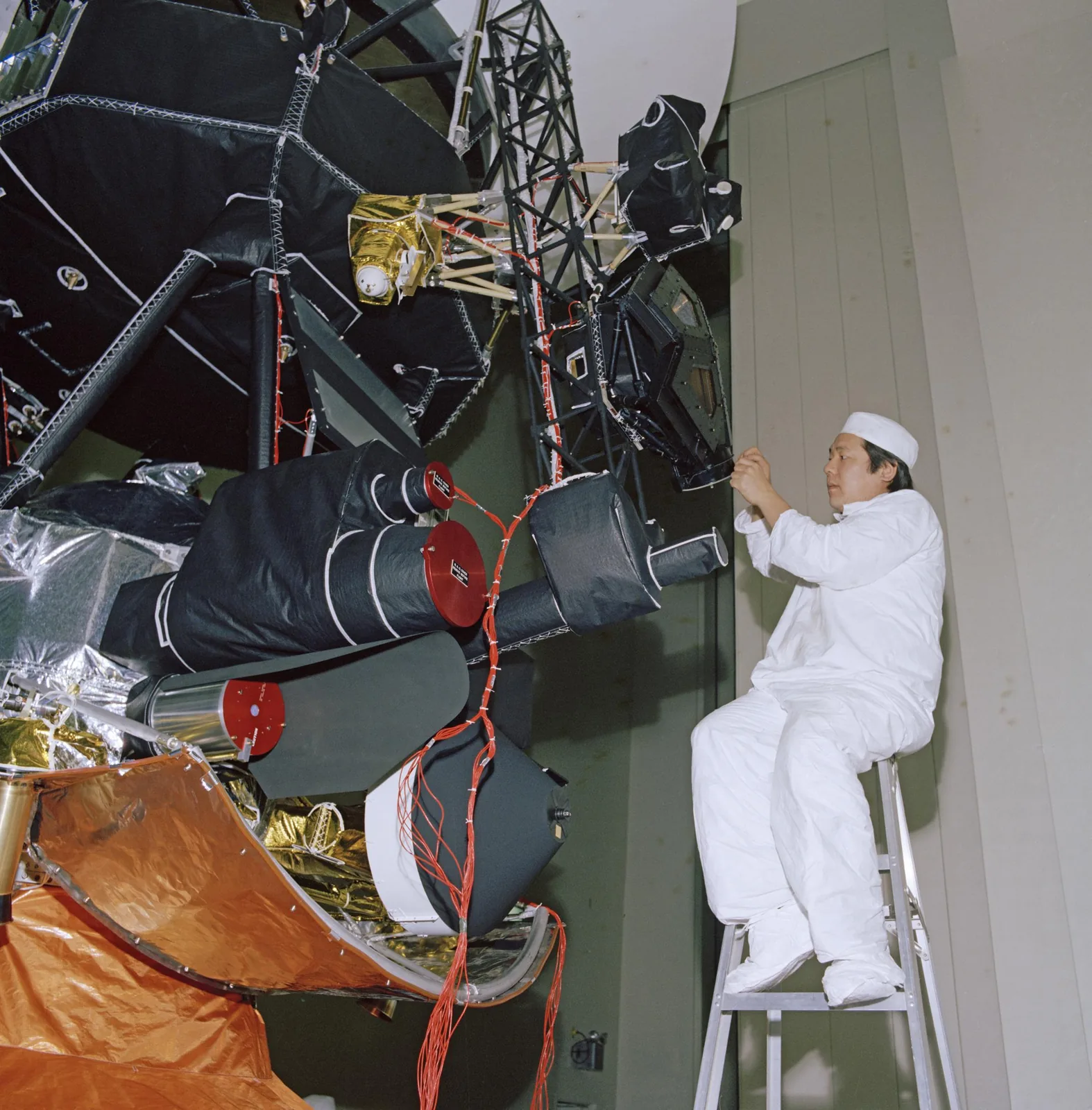
NASA's space probe launched in 1977, the most distant human-made object.
Measured
- From the Sun today
- 172 AU (25.8 billion km)
- Moving outward
- 3.56 AU a year (16.9 km/s)
- Constellation
- Ophiuchus
- Position (J2000)
- RA 17h 15m 53s, Dec +12.22°
How far, from the Sun
172 AU. To cross it:
- Light24 hours
- Voyager 1's speed48.4 years
- Driving at 100 km/h29,400 years
Voyager 1 at the speed it moved outward over the year to 2026-10-25 (JPL Horizons). Driving: nonstop, never refuelling.
Facts
- Launched on 5 September 1977, it flew past Jupiter in 1979 and Saturn in 1980.
- It became the first spacecraft to enter interstellar space, in August 2012.
- On 25 August 2012 its counts of cosmic rays from the galaxy jumped and the Sun's own particles fell away almost to nothing — the heliopause, measured (Stone et al. 2013).
- Radio signals take about 24 hours to reach it: NASA dates its arrival at one light-day from Earth to 18 November 2026.
- Before Jupiter it was too slow to ever leave the Sun: 13.7 km/s, with 19.1 needed there. Jupiter's pull changed that.
- Jupiter, 5 March 1979: 13.7 → 23.3 km/s against the Sun.
- Saturn, 12 November 1980: 20.3 → 21.4 km/s against the Sun.
- Speeds from its trajectory, about two to three months each side of the pass (JPL Horizons).
Where this comes from
- JPL Horizons heliocentric ephemeris, 2026-10-25 (Voyager 1 172.15 AU, Voyager 2 144.29 AU, New Horizons 65.90 AU)
Every catalogue Ouranos draws is credited on the credits page.