Supernova remnant
The Veil Nebula
Also Cygnus Loop · NGC 6960 · NGC 6992
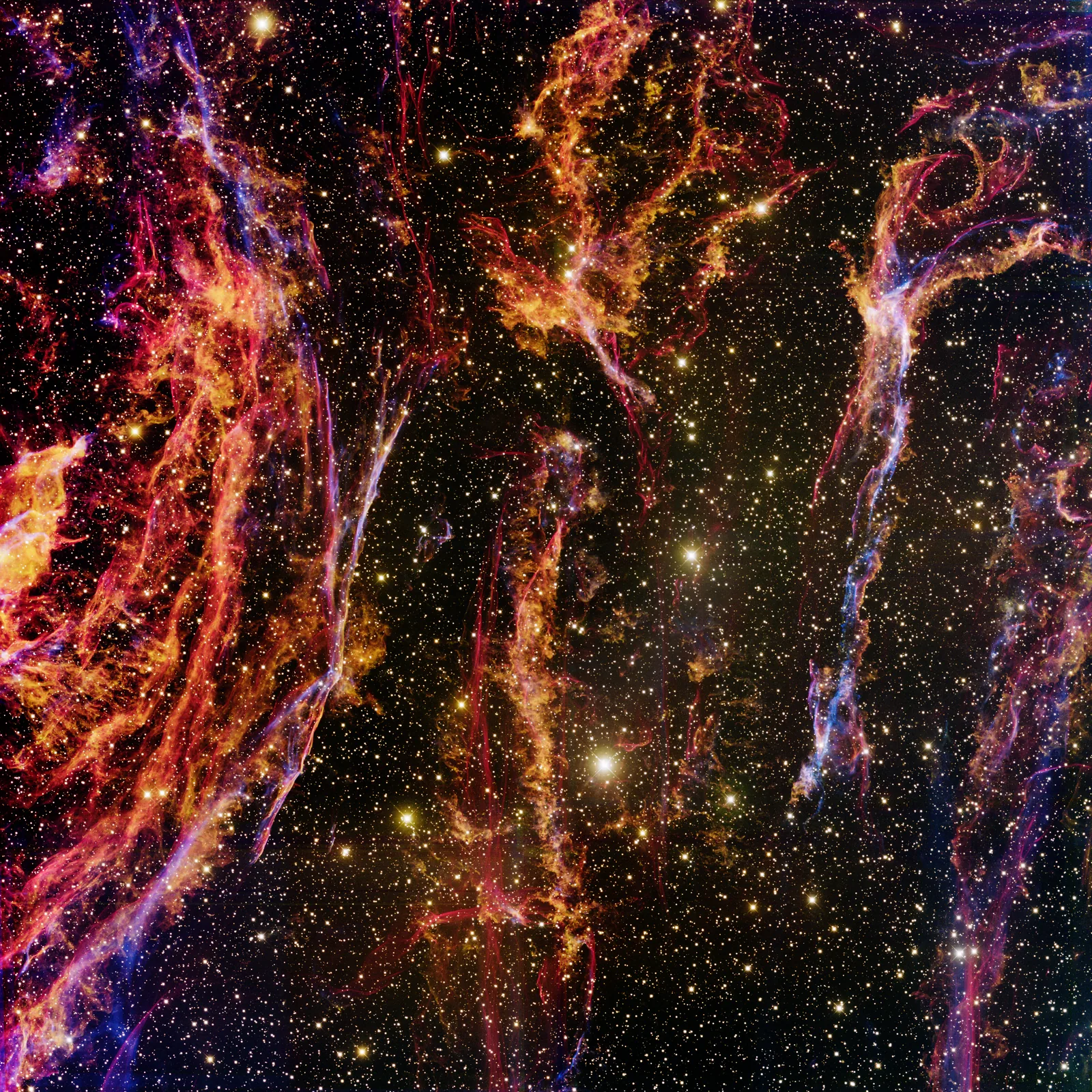
The shredded, glowing shell of a star that exploded thousands of years ago, also called the Cygnus Loop.
Measured
- Distance
- about 2,400 light-years (published estimates 2,320–2,480)
- Size
- about 120 light-years across (approximate)
- Constellation
- Cygnus
- Position (J2000)
- RA 20h 45m 38s, Dec +30.71°
How far, from the Sun
About 2,400 light-years. To cross it:
- Light2,400 years
- Voyager 1's speed42.6 million years
- Driving at 100 km/h25.9 billion years
Voyager 1 at the speed it moved outward over the year to 2026-10-25 (JPL Horizons). Driving: nonstop, never refuelling.
Facts
- Estimates of when the supernova went off range from about 5,000 to 20,000 years ago.
- The whole loop spans about 3 degrees of sky, six times the width of the full Moon.
How it was found
- William Herschel discovered it in 1784.
Where this comes from
- Fesen et al. 2018/2021, Gaia parallaxes of stars in front of and behind it (735 ± 25 pc)
Every catalogue Ouranos draws is credited on the credits page.