Emission nebula
The Tarantula Nebula
Also 30 Doradus · NGC 2070
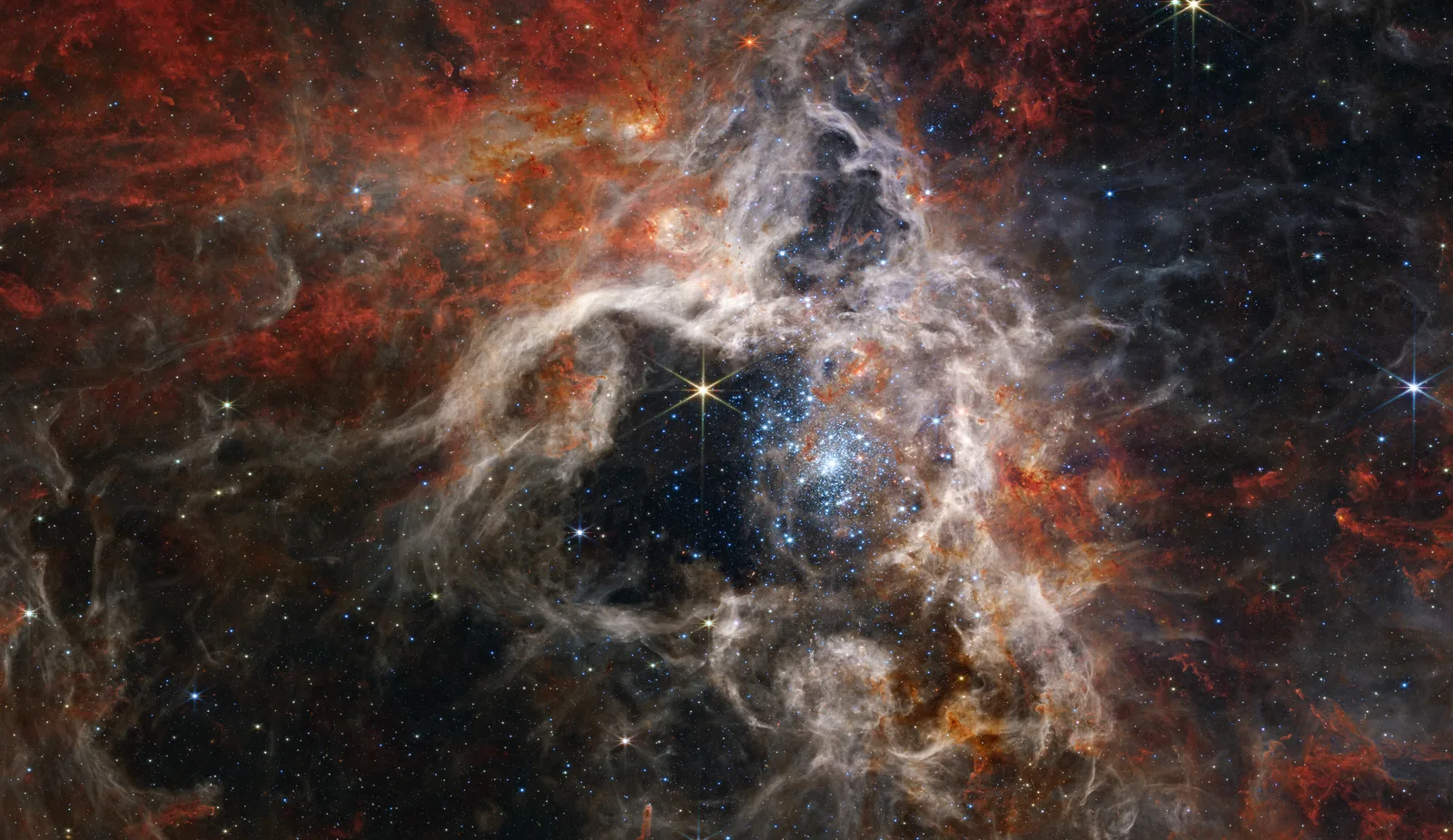
A giant star-forming region in the Large Magellanic Cloud, the most active one known in our Local Group.
Measured
- Distance
- about 160,000 light-years (published estimates 150,000–170,000)
- Size
- about 1,860 light-years across (approximate)
- Constellation
- Dorado
- Position (J2000)
- RA 5h 38m 38s, Dec −69.09°
How far, from the Sun
About 160,000 light-years. To cross it:
- Light160,000 years
- Voyager 1's speed2.84 billion years
- Driving at 100 km/h1.73 trillion years
Voyager 1 at the speed it moved outward over the year to 2026-10-25 (JPL Horizons). Driving: nonstop, never refuelling.
Facts
- It is the most active star-forming region known in the Local Group of galaxies.
- Its central cluster R136 holds R136a1, among the most massive stars known, with estimates from about 150 to 265 Suns.
How it was found
- Nicolas-Louis de Lacaille recorded it in 1751.
Where this comes from
- Pietrzyński et al. 2019, Nature 567, 200, distance of the Large Magellanic Cloud (49.59 kpc)
Every catalogue Ouranos draws is credited on the credits page.