Planetary nebula
The Southern Ring Nebula
Also NGC 3132 · Caldwell 74 · Eight-Burst Nebula
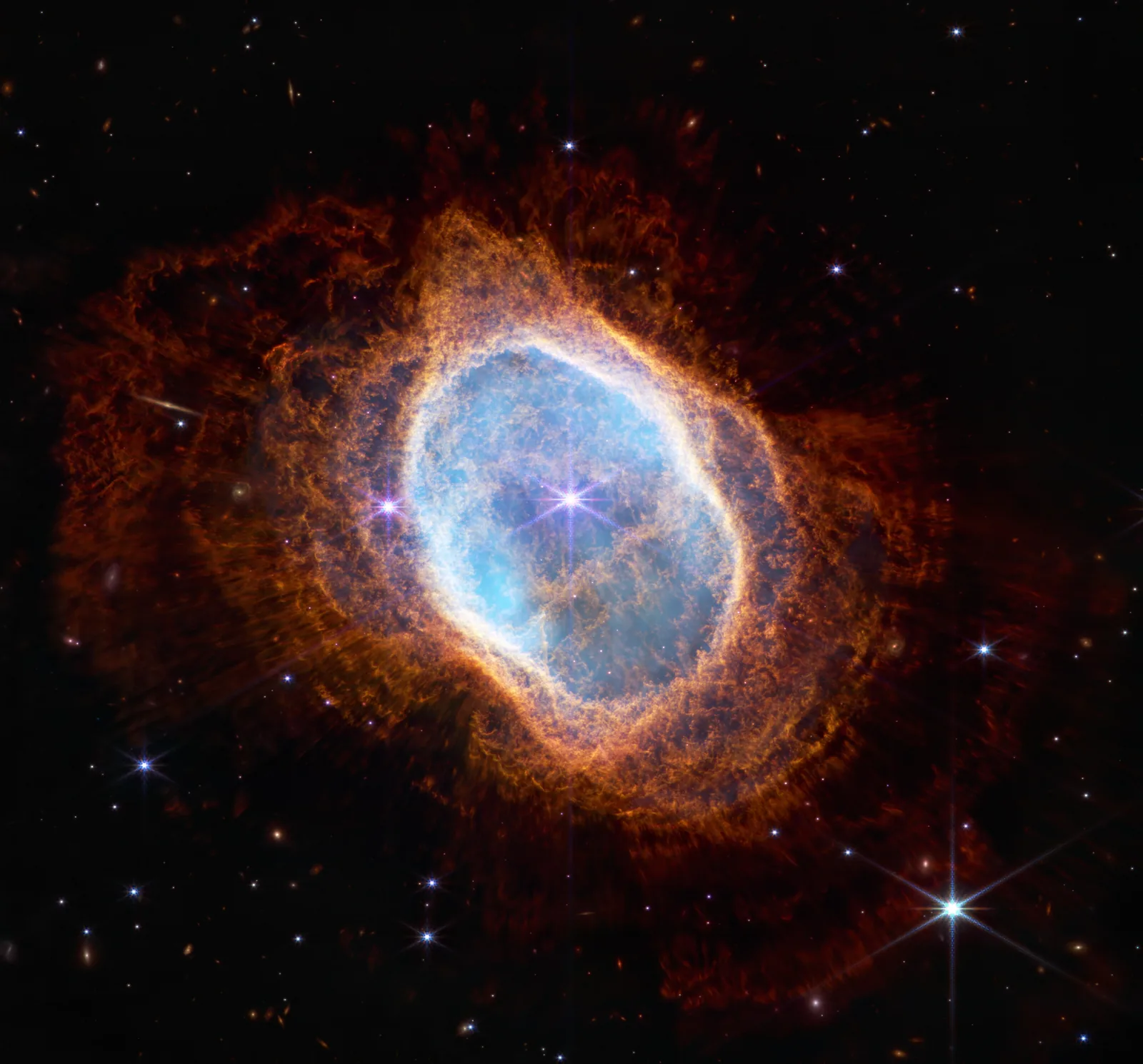
A planetary nebula of gas shells around a dying star in a binary, imaged in detail by JWST.
Measured
- Distance
- 2,471 light-years
- Size
- about 0.8 light-years across (approximate)
- Constellation
- Vela
- Position (J2000)
- RA 10h 07m 02s, Dec −40.44°
How far, from the Sun
2,470 light-years. To cross it:
- Light2,470 years
- Voyager 1's speed43.9 million years
- Driving at 100 km/h26.7 billion years
Voyager 1 at the speed it moved outward over the year to 2026-10-25 (JPL Horizons). Driving: nonstop, never refuelling.
Facts
- It was one of the first images released by the James Webb Space Telescope, in July 2022.
- Webb gave the clearest view yet of the star that made the nebula, the fainter of the two at its centre.
How it was found
- John Herschel discovered it in 1835.
Where this comes from
- Gaia DR3 parallax of the central star, 1.3198 ± 0.0344 mas (758 pc) (Gaia Collaboration 2023, A&A 674, A1)
Every catalogue Ouranos draws is credited on the credits page.