Supernova remnant
Supernova 1987A
Also SN 1987A
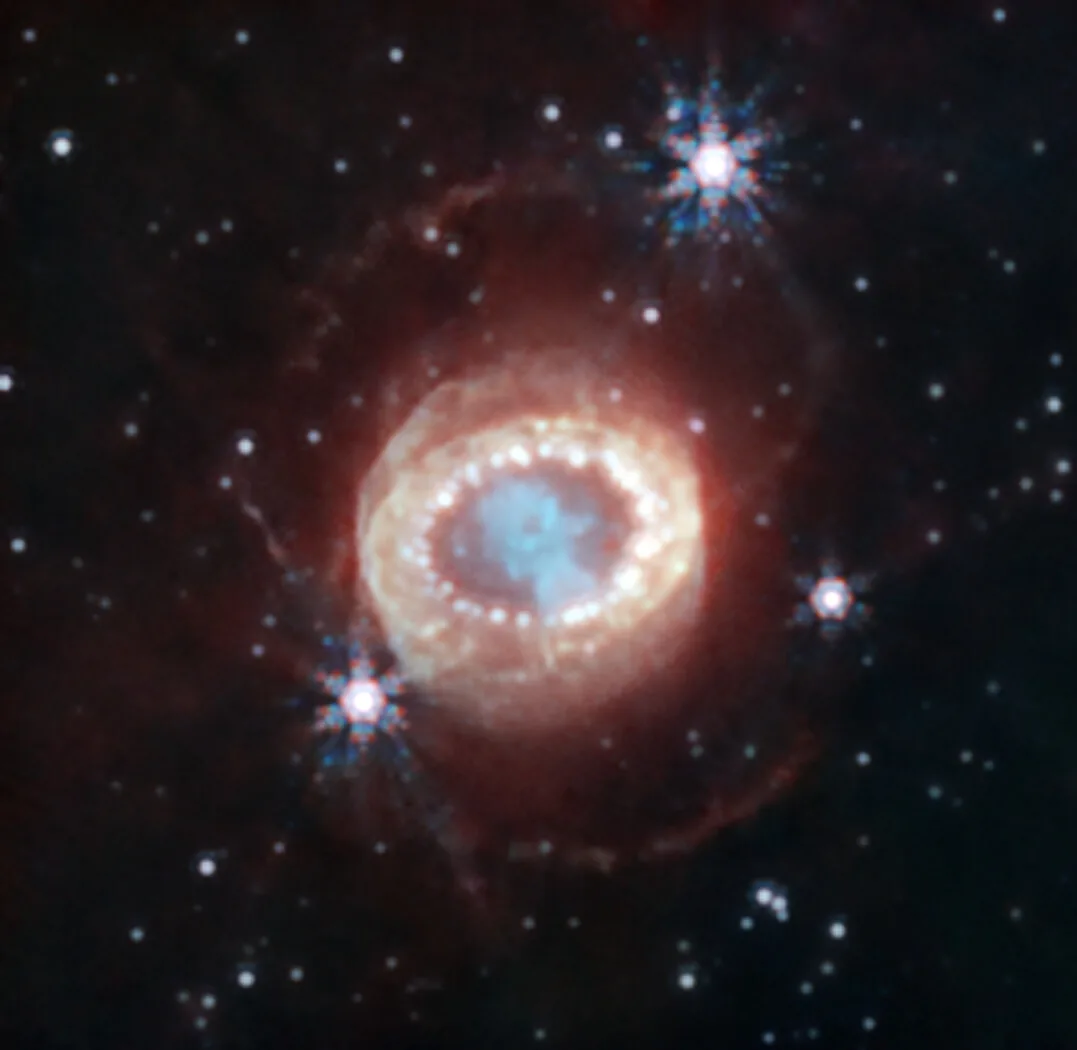
A star that exploded in the Large Magellanic Cloud, seen from Earth in February 1987.
Measured
- Distance
- about 168,000 light-years (published estimates 164,000–172,000)
- Constellation
- Dorado
- Position (J2000)
- RA 5h 35m 28s, Dec −69.27°
How far, from the Sun
About 168,000 light-years. To cross it:
- Light168,000 years
- Voyager 1's speed2.99 billion years
- Driving at 100 km/h1.81 trillion years
Voyager 1 at the speed it moved outward over the year to 2026-10-25 (JPL Horizons). Driving: nonstop, never refuelling.
Facts
- About two dozen neutrinos from the blast were detected on Earth hours before its light arrived.
- Its light left the star about 168,000 years before it reached us.
- In 2024 JWST found evidence of a neutron star hidden in its debris.
How it was found
- First seen on 24 February 1987, it was the closest observed supernova since Kepler's in 1604.
Where this comes from
- Panagia 1999, light-echo ring geometry (51.4 ± 1.2 kpc)
Every catalogue Ouranos draws is credited on the credits page.