Supernova remnant
SN 1006
Also SNR G327.6+14.6 · PKS 1459-41
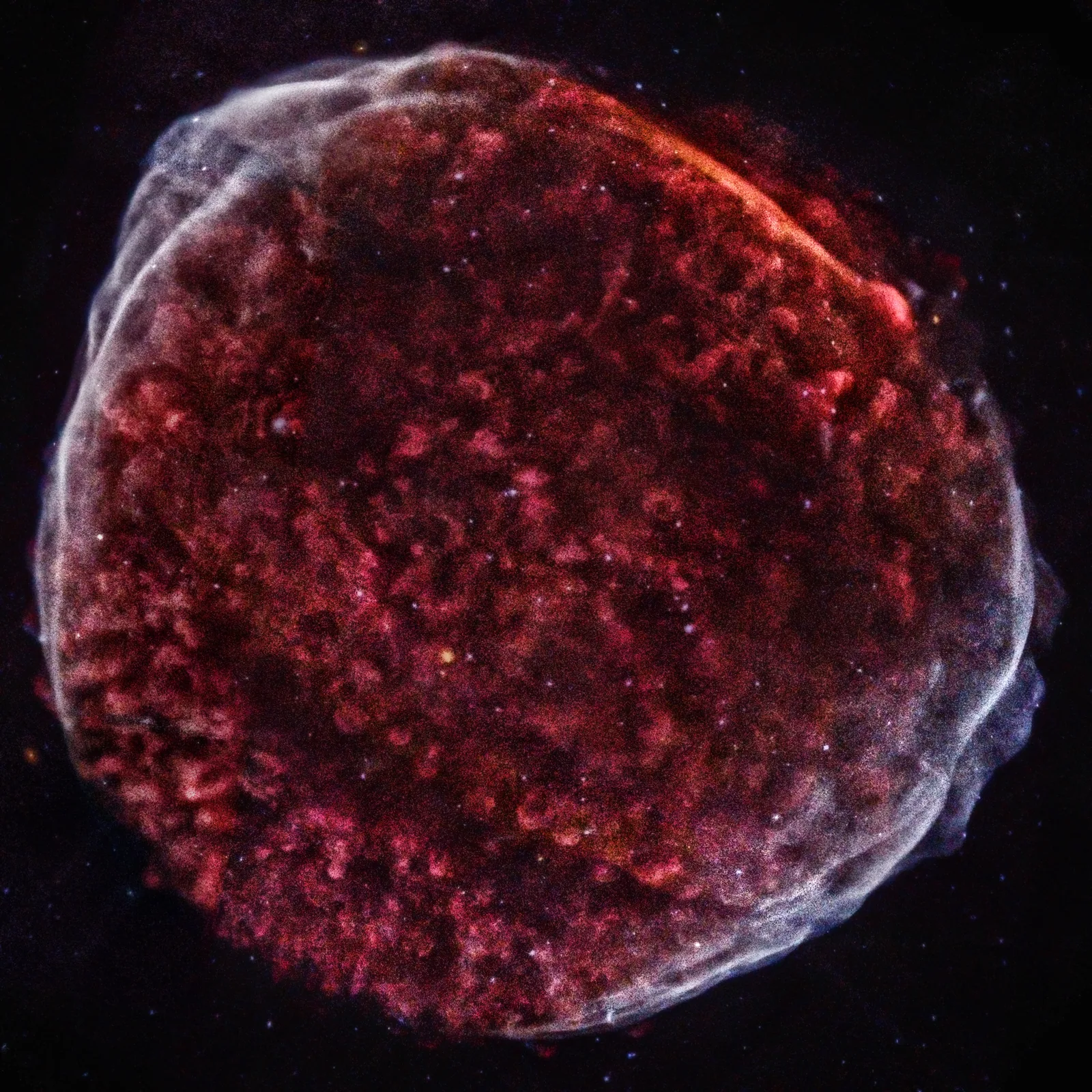
The remnant of probably the brightest supernova in recorded history, seen in the year 1006.
Measured
- Distance
- about 7,078 light-years (published estimates 6,816–7,339)
- Size
- about 60 light-years across (approximate)
- Constellation
- Lupus / Centaurus
- Position (J2000)
- RA 15h 02m 08s, Dec −41.95°
How far, from the Sun
About 7,080 light-years. To cross it:
- Light7,080 years
- Voyager 1's speed126 million years
- Driving at 100 km/h76.4 billion years
Voyager 1 at the speed it moved outward over the year to 2026-10-25 (JPL Horizons). Driving: nonstop, never refuelling.
Facts
- Its peak brightness is estimated at about magnitude −7.5, far brighter than Venus.
- It is generally taken to have been a Type Ia supernova, the explosion of a white dwarf.
- It is traditionally placed in Lupus, but it straddles the IAU line: its centre lies just inside Centaurus (Roman 1987 boundaries).
How it was found
- Observers in China, Japan, Egypt, Iraq and Europe recorded it in 1006.
Where this comes from
- Winkler et al. 2003 (2.17 ± 0.08 kpc)
Every catalogue Ouranos draws is credited on the credits page.