White dwarf
Sirius B
Also Alpha Canis Majoris B · WD 0642-166
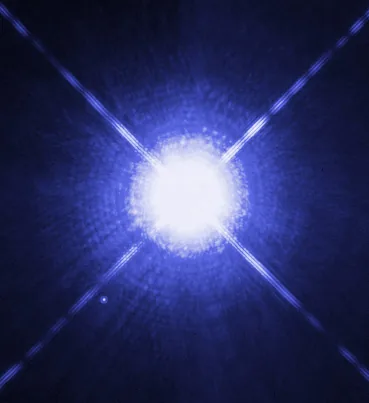
The white dwarf companion of Sirius, the brightest star in the night sky.
Measured
- Distance
- 8.6 light-years
- Constellation
- Canis Major
- Position (J2000)
- RA 6h 45m 09s, Dec −16.72°
How far, from the Sun
8.6 light-years. To cross it:
- Light8.6 years
- Voyager 1's speed153,000 years
- Driving at 100 km/h92.8 million years
Voyager 1 at the speed it moved outward over the year to 2026-10-25 (JPL Horizons). Driving: nonstop, never refuelling.
Facts
- It packs about 1.02 Suns of mass into a ball slightly smaller than Earth.
- Friedrich Bessel predicted it in 1844 from Sirius's wobble; Alvan Graham Clark first saw it in 1862.
- It is the nearest known white dwarf to the Sun.
Where this comes from
- Hipparcos parallax of Sirius, 379.21 ± 1.58 mas (van Leeuwen 2007, A&A 474, 653)
Every catalogue Ouranos draws is credited on the credits page.