Globular cluster
Omega Centauri
Also NGC 5139 · ω Cen · Caldwell 80
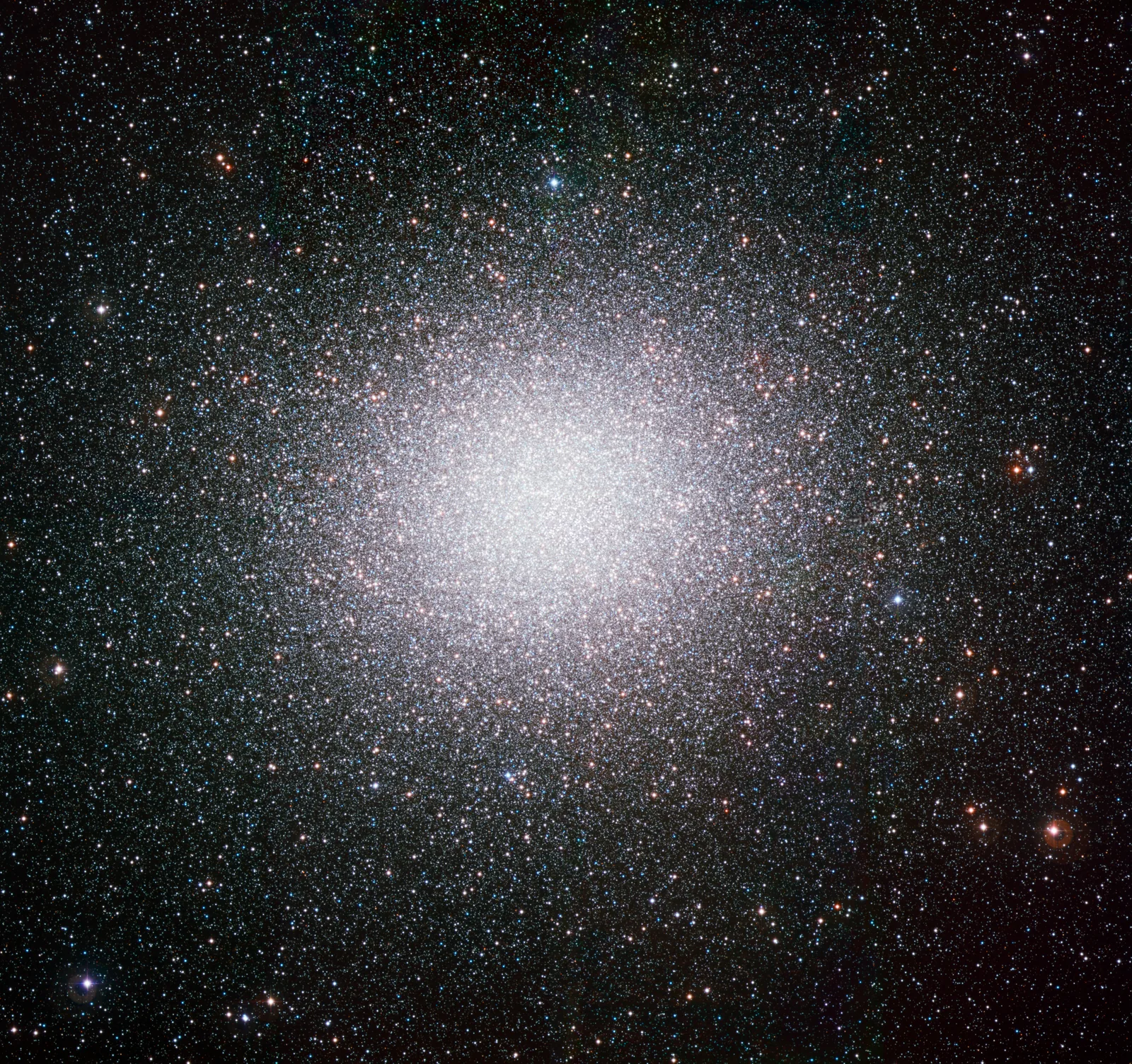
The largest globular cluster in our galaxy, holding millions of stars, possibly a dwarf galaxy stripped of its outer stars.
Measured
- Distance
- about 17,700 light-years (published estimates 17,550–17,870)
- Size
- about 172 light-years across (approximate)
- Constellation
- Centaurus
- Position (J2000)
- RA 13h 26m 47s, Dec −47.48°
How far, from the Sun
About 17,700 light-years. To cross it:
- Light17,700 years
- Voyager 1's speed315 million years
- Driving at 100 km/h191 billion years
Voyager 1 at the speed it moved outward over the year to 2026-10-25 (JPL Horizons). Driving: nonstop, never refuelling.
Facts
- Its mass is about 3.9 million times the Sun's, the most of any known Milky Way globular.
- Ptolemy listed it as a star; Edmond Halley saw it was a nebula in 1677.
- In 2024 Hubble data revealed a black hole of at least 8,200 solar masses near its centre.
- Many astronomers think it is the core of a small galaxy the Milky Way absorbed.
Where this comes from
- Baumgardt & Vasiliev 2021, Gaia EDR3 (5.43 ± 0.05 kpc)
Every catalogue Ouranos draws is credited on the credits page.