Star
Mira
Also Omicron Ceti · 68 Ceti
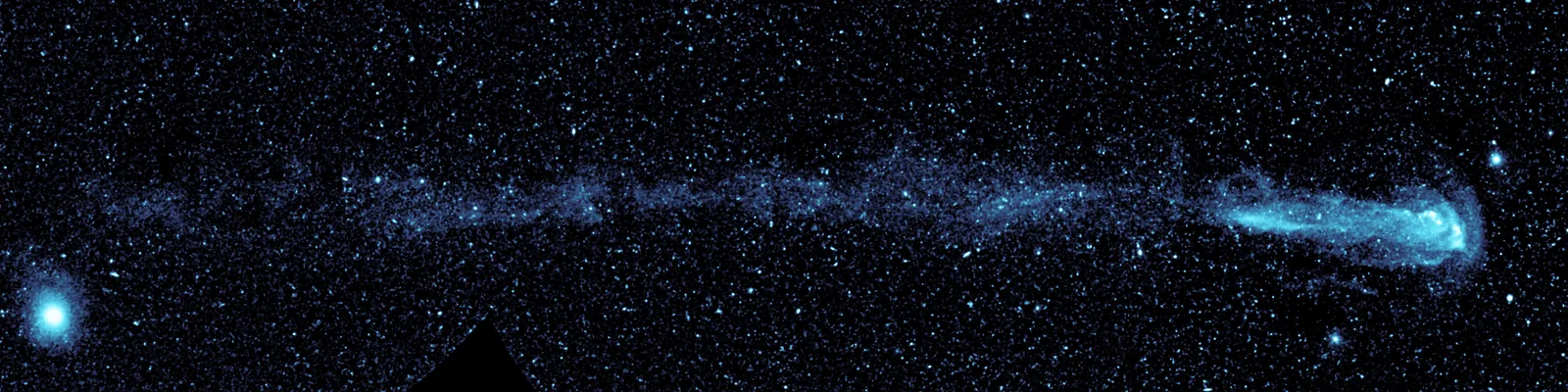
A pulsating red giant that brightens and fades over about 11 months, the prototype of the long-period variables named after it.
Measured
- Distance
- about 300 light-years (published estimates 270–340)
- Constellation
- Cetus
- Position (J2000)
- RA 2h 19m 21s, Dec −2.98°
How far, from the Sun
About 300 light-years. To cross it:
- Light300 years
- Voyager 1's speed5.33 million years
- Driving at 100 km/h3.24 billion years
Voyager 1 at the speed it moved outward over the year to 2026-10-25 (JPL Horizons). Driving: nonstop, never refuelling.
Facts
- It swings from about magnitude 3, sometimes 2, down to 10 over a cycle of about 332 days.
- David Fabricius is credited with discovering its changing brightness in 1596.
- In 2007 the GALEX telescope found a 13-light-year tail of gas trailing behind it.
- Johannes Hevelius named it Mira, "The Wonderful", in 1642.
Where this comes from
- Hipparcos parallax 10.91 ± 1.22 mas (van Leeuwen 2007, A&A 474, 653)
Every catalogue Ouranos draws is credited on the credits page.