Emission nebula
The Orion Nebula
Also M42 · NGC 1976
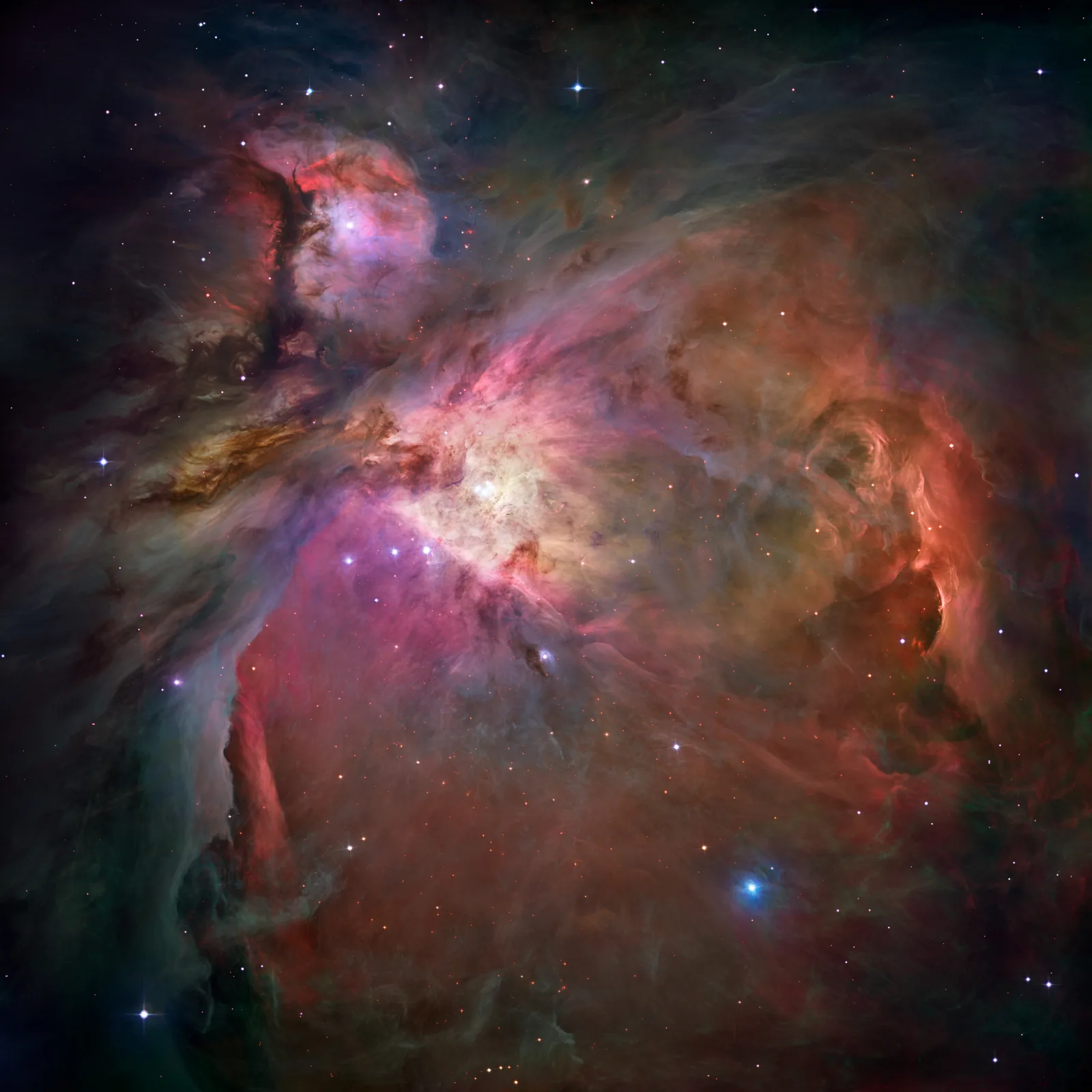
A glowing cloud of gas and dust where thousands of stars are being born, visible to the naked eye in Orion's sword.
Measured
- Distance
- about 1,300 light-years (published estimates 1,265–1,350)
- Size
- about 24 light-years across (approximate)
- Constellation
- Orion
- Position (J2000)
- RA 5h 35m 17s, Dec −5.39°
How far, from the Sun
About 1,300 light-years. To cross it:
- Light1,300 years
- Voyager 1's speed23.1 million years
- Driving at 100 km/h14 billion years
Voyager 1 at the speed it moved outward over the year to 2026-10-25 (JPL Horizons). Driving: nonstop, never refuelling.
Facts
- It is the nearest large region of massive star birth known, about 1,300 light years away.
- It is lit by the Trapezium, a young cluster whose brightest star is about 38 times the Sun's mass.
- Hubble has imaged more than 150 dusty discs around its young stars, where planets may form.
How it was found
- Charles Messier added it to his catalogue in 1769.
Where this comes from
- VLBA radio parallaxes: Kounkel et al. 2017 (388 ± 5 pc) and Menten et al. 2007 (414 ± 7 pc)
Every catalogue Ouranos draws is credited on the credits page.