Galaxy
The Andromeda Galaxy
Also M31 · NGC 224
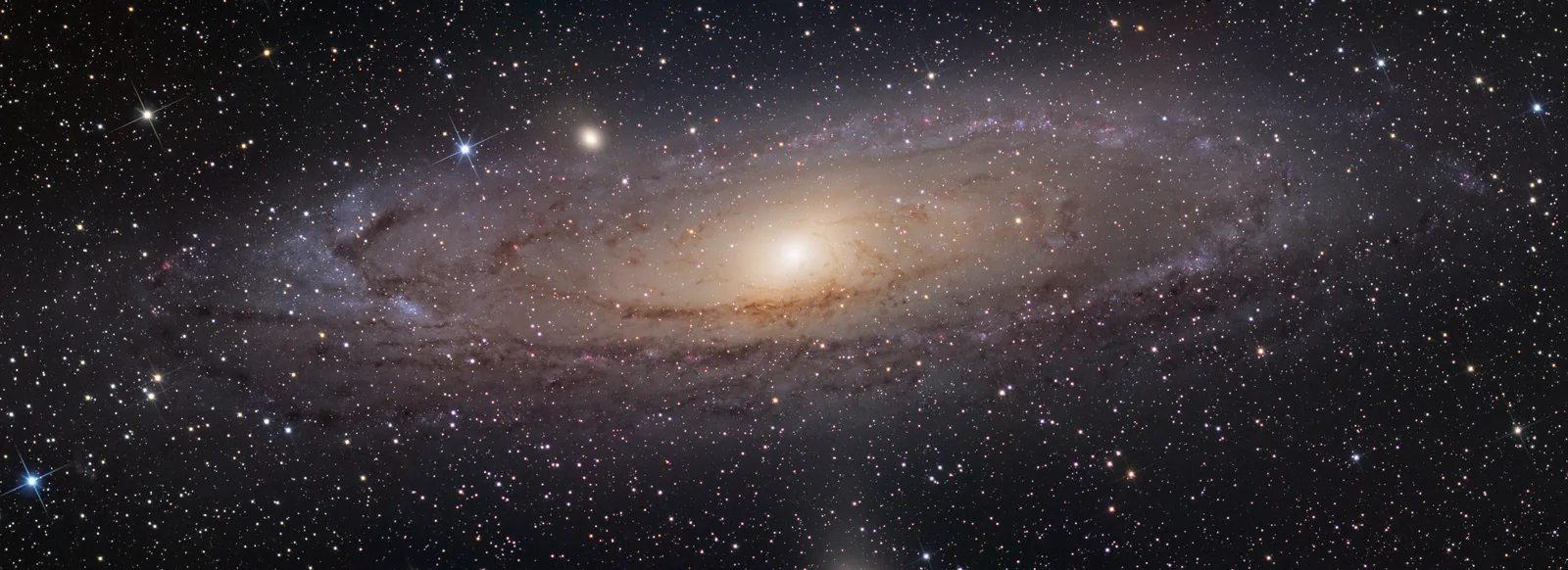
The nearest large spiral galaxy to the Milky Way, holding roughly a trillion stars.
Measured
- Distance
- about 2.5 million light-years (published estimates 2.4 million–2.6 million)
- Size
- about 152,000 light-years across (approximate)
- Constellation
- Andromeda
- Position (J2000)
- RA 0h 42m 44s, Dec +41.27°
How far, from the Sun
About 2.5 million light-years. To cross it:
- Light2.5 million years
- Voyager 1's speed44.4 billion years
- Driving at 100 km/h27 trillion years
Voyager 1 at the speed it moved outward over the year to 2026-10-25 (JPL Horizons). Driving: nonstop, never refuelling.
Facts
- It is the most distant object easily visible to the unaided eye.
- Edwin Hubble found a Cepheid in it in 1923 and announced in 1925 that it lies far outside our galaxy.
- It is approaching the Milky Way at about 110 km per second.
- Its light left it about 2.5 million years ago.
In and around it
M31* and the double nucleusPA-99-N2b (candidate)M32Andromeda IXNGC 205Andromeda IAndromeda XVIIAndromeda XXVIIAndromeda IIIAndromeda XXVAndromeda XXVIAndromeda VAndromeda XIAndromeda XIXAndromeda XXIIIAndromeda XXAndromeda XIIIAndromeda XAndromeda XXINGC 147Andromeda XXXIIAndromeda XXXAndromeda XIVAndromeda XIIAndromeda XVAndromeda IINGC 185Andromeda XXIXM33 (Triangulum)Andromeda XXIVAndromeda VIIIC 10Andromeda XXXILGS 3Andromeda VIAndromeda XXIIAndromeda XVIAndromeda XXXIIIAndromeda XXVIIIAndromeda XVIIIPegasus dwarf irregularPegasus VAndromeda XXXVAndromeda XXXVI
Where this comes from
- Li et al. 2021, ApJ 920, 84, Cepheids (761 ± 11 kpc)
Every catalogue Ouranos draws is credited on the credits page.