Planetary nebula
The Dumbbell Nebula
Also M27 · NGC 6853
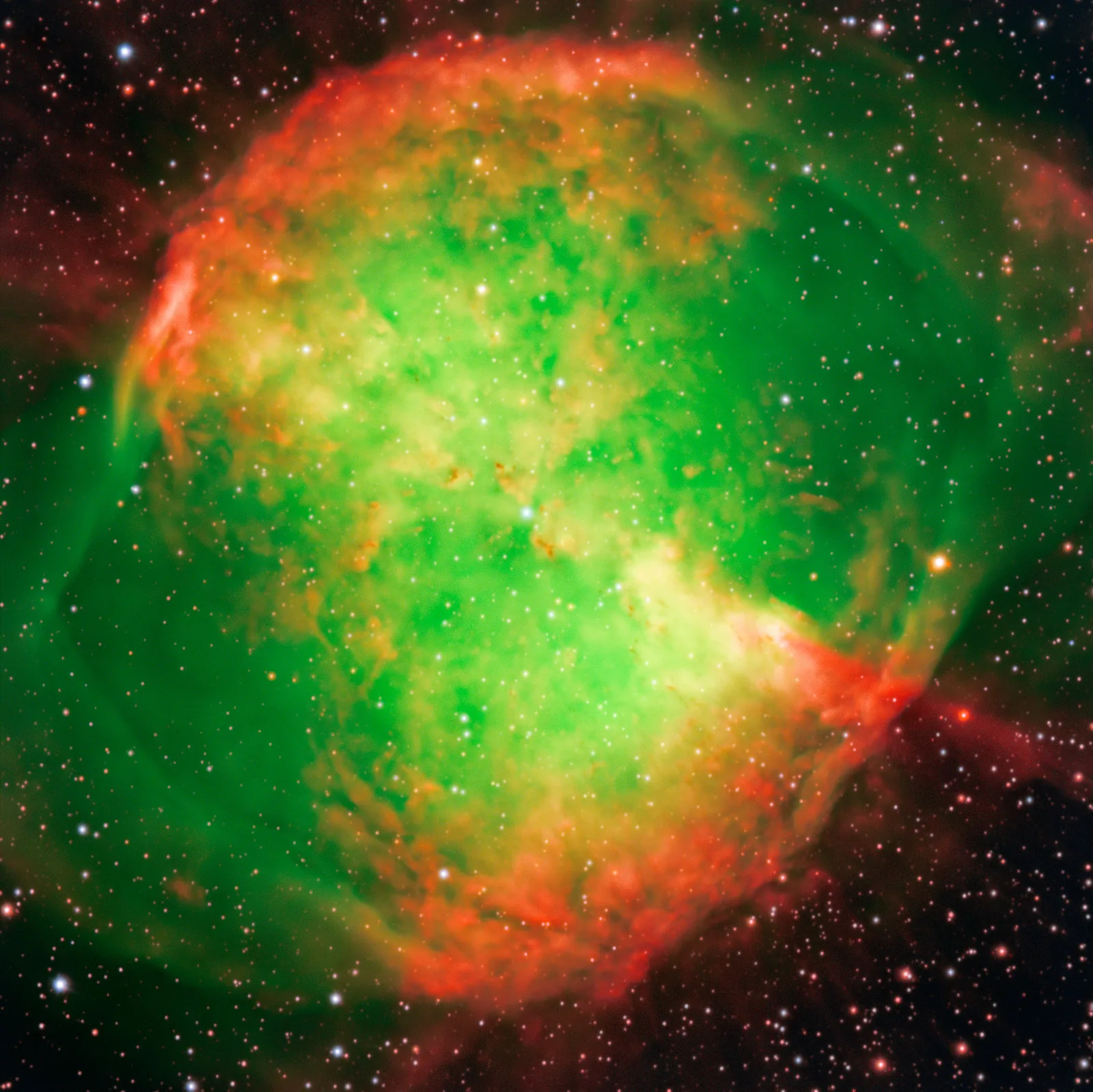
A bright planetary nebula, the gas shell of a dying star, shaped like an apple core or dumbbell.
Measured
- Distance
- about 1,270 light-years (published estimates 1,250–1,320)
- Size
- about 2.88 light-years across (approximate)
- Constellation
- Vulpecula
- Position (J2000)
- RA 19h 59m 36s, Dec +22.72°
How far, from the Sun
About 1,270 light-years. To cross it:
- Light1,270 years
- Voyager 1's speed22.6 million years
- Driving at 100 km/h13.7 billion years
Voyager 1 at the speed it moved outward over the year to 2026-10-25 (JPL Horizons). Driving: nonstop, never refuelling.
Facts
- At magnitude 7.5 it is bright enough to see in binoculars.
How it was found
- It was the first planetary nebula ever discovered, by Charles Messier in 1764.
Where this comes from
- Gaia DR3 parallax of the central star, 2.5700 ± 0.0373 mas (Gaia Collaboration 2023, A&A 674, A1)
Every catalogue Ouranos draws is credited on the credits page.