Galaxy
The Pinwheel Galaxy
Also M101 · NGC 5457
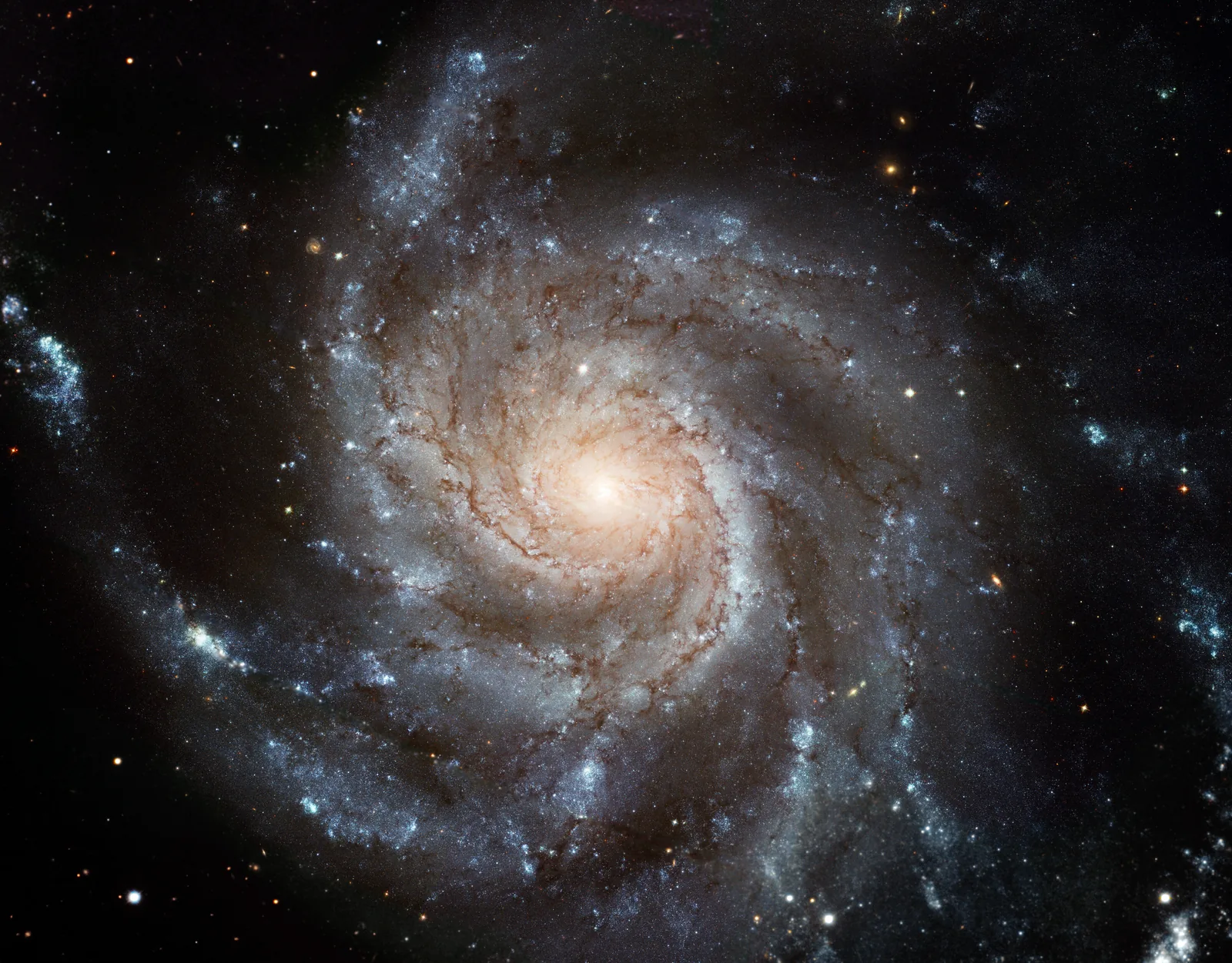
A large face-on spiral galaxy in Ursa Major, with lopsided arms full of star-forming regions.
Measured
- Distance
- about 21.6 million light-years (published estimates 21.3 million–21.9 million)
- Size
- about 252,000 light-years across (approximate)
- Constellation
- Ursa Major
- Position (J2000)
- RA 14h 03m 13s, Dec +54.35°
How far, from the Sun
About 21.6 million light-years. To cross it:
- Light21.6 million years
- Voyager 1's speed384 billion years
- Driving at 100 km/h233 trillion years
Voyager 1 at the speed it moved outward over the year to 2026-10-25 (JPL Horizons). Driving: nonstop, never refuelling.
Facts
- In 2011 it hosted SN 2011fe, one of the closest Type Ia supernovae seen in decades.
How it was found
- Pierre Méchain discovered it in 1781.
Where this comes from
- NED mean of published distances (6.644 Mpc)
Every catalogue Ouranos draws is credited on the credits page.