Supernova remnant
The Crab Nebula
Also M1 · NGC 1952 · Taurus A
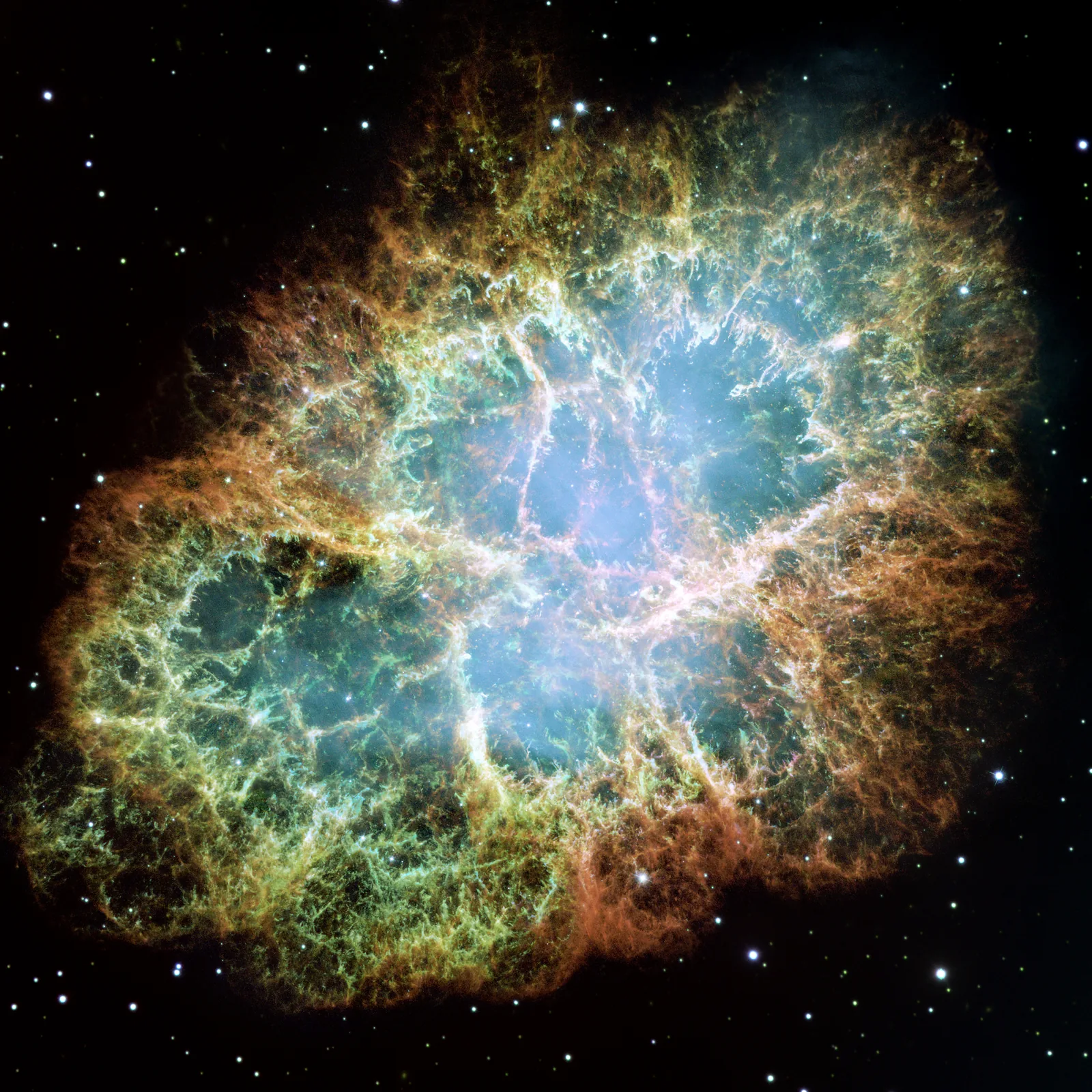
The expanding wreck of a star whose explosion was seen from Earth in 1054.
Measured
- Distance
- about 6,500 light-years (published estimates 4,900–8,100)
- Size
- about 11 light-years across (approximate)
- Constellation
- Taurus
- Position (J2000)
- RA 5h 34m 32s, Dec +22.02°
How far, from the Sun
About 6,500 light-years. To cross it:
- Light6,500 years
- Voyager 1's speed116 million years
- Driving at 100 km/h70.2 billion years
Voyager 1 at the speed it moved outward over the year to 2026-10-25 (JPL Horizons). Driving: nonstop, never refuelling.
Facts
- At its heart is the Crab pulsar, a neutron star spinning about 30 times a second.
- Its gas is still flying outward at over 1,000 km per second.
- It is the first entry in Charles Messier's catalogue; he saw it in 1758.
How it was found
- Chinese astronomers recorded the supernova in 1054; it was visible in daylight for about 23 days.
Where this comes from
- Bühler & Blandford 2014, Rep. Prog. Phys. 77, 066901 (about 2 kpc, after Trimble 1973)
Every catalogue Ouranos draws is credited on the credits page.