Galaxy
The Large Magellanic Cloud
Also LMC
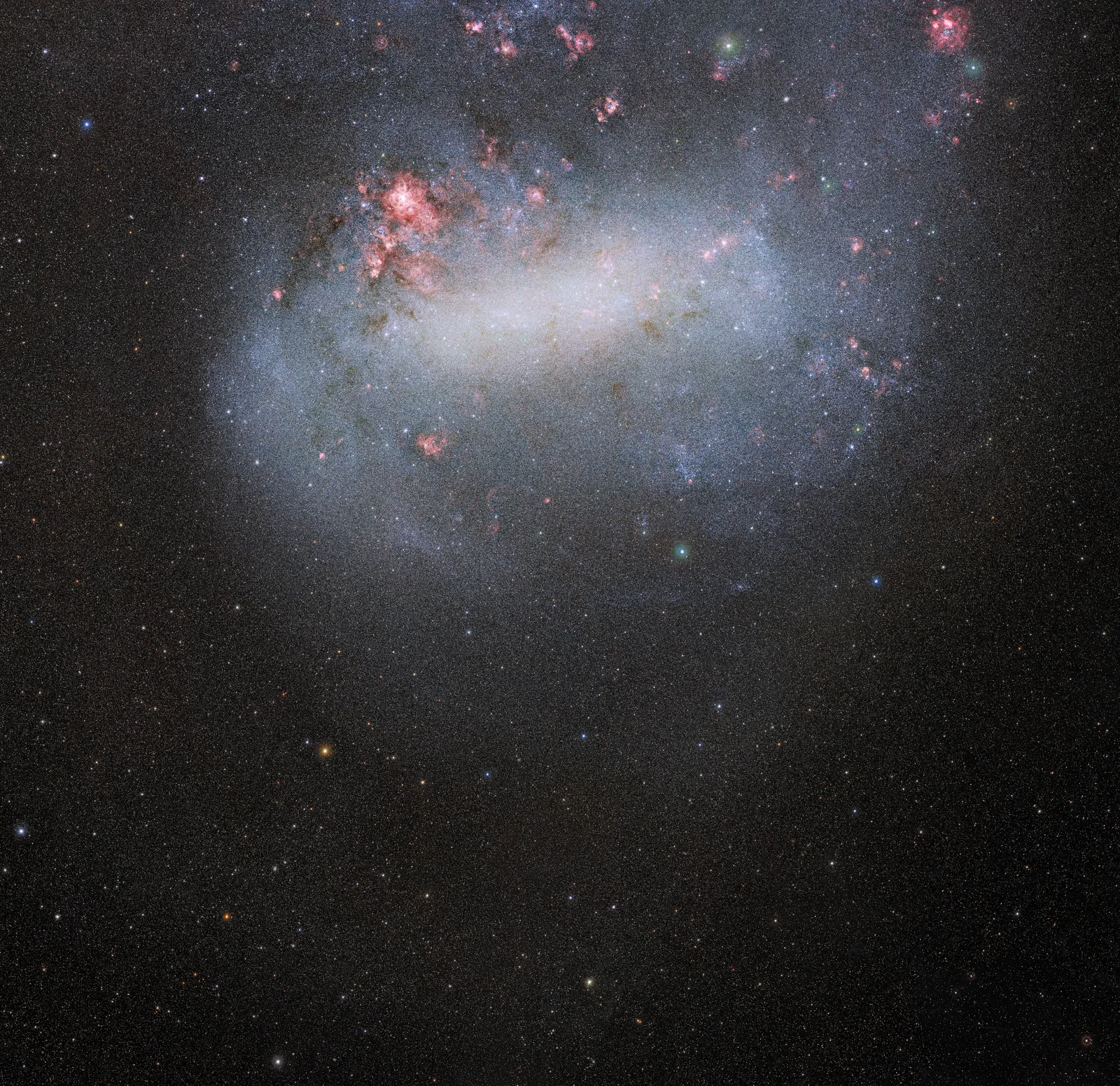
A dwarf satellite galaxy of the Milky Way, seen from the southern hemisphere as a fuzzy, cloud-like patch.
Measured
- Distance
- about 161,700 light-years (published estimates 160,000–163,500)
- Size
- about 32,200 light-years across (approximate)
- Constellation
- Dorado
- Position (J2000)
- RA 5h 23m 34s, Dec −69.76°
How far, from the Sun
About 162,000 light-years. To cross it:
- Light162,000 years
- Voyager 1's speed2.87 billion years
- Driving at 100 km/h1.75 trillion years
Voyager 1 at the speed it moved outward over the year to 2026-10-25 (JPL Horizons). Driving: nonstop, never refuelling.
Facts
- The Persian astronomer al-Sufi's book of about 964 holds what is thought to be its earliest mention.
- It hosts the Tarantula Nebula and the supernova SN 1987A.
- Its distance was measured to about 1% using eclipsing binary stars in 2019.
Where this comes from
- Pietrzyński et al. 2019, eclipsing binaries (49.59 ± 0.55 kpc)
Every catalogue Ouranos draws is credited on the credits page.