Supernova remnant
Kepler's Supernova Remnant
Also SN 1604 · G4.5+6.8
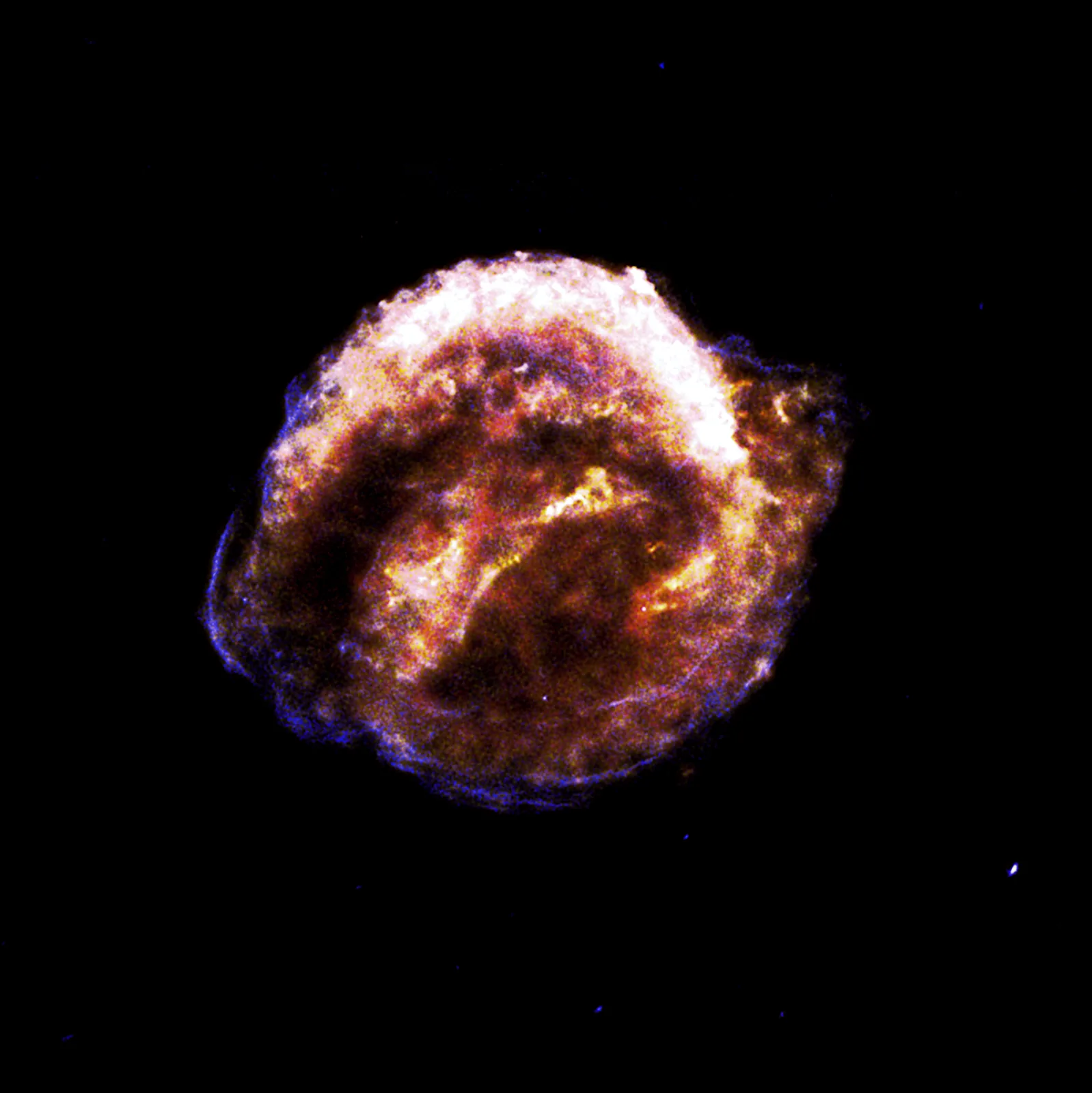
The remains of the most recent supernova in our galaxy that people saw with the naked eye.
Measured
- Distance
- about 16,600 light-years (published estimates 14,400–19,200)
- Size
- about 18 light-years across (approximate)
- Constellation
- Ophiuchus
- Position (J2000)
- RA 17h 30m 42s, Dec −21.48°
How far, from the Sun
About 16,600 light-years. To cross it:
- Light16,600 years
- Voyager 1's speed295 million years
- Driving at 100 km/h179 billion years
Voyager 1 at the speed it moved outward over the year to 2026-10-25 (JPL Horizons). Driving: nonstop, never refuelling.
Facts
- It was first noticed on 9 October 1604; Johannes Kepler studied it for a year.
- At its peak it outshone Jupiter.
- As of 2026 no later supernova in the Milky Way has been seen with the naked eye.
Where this comes from
- Sankrit et al. 2016 (5.1 +0.8/−0.7 kpc)
Every catalogue Ouranos draws is credited on the credits page.