Star with planets
K2-18
Also EPIC 201912552
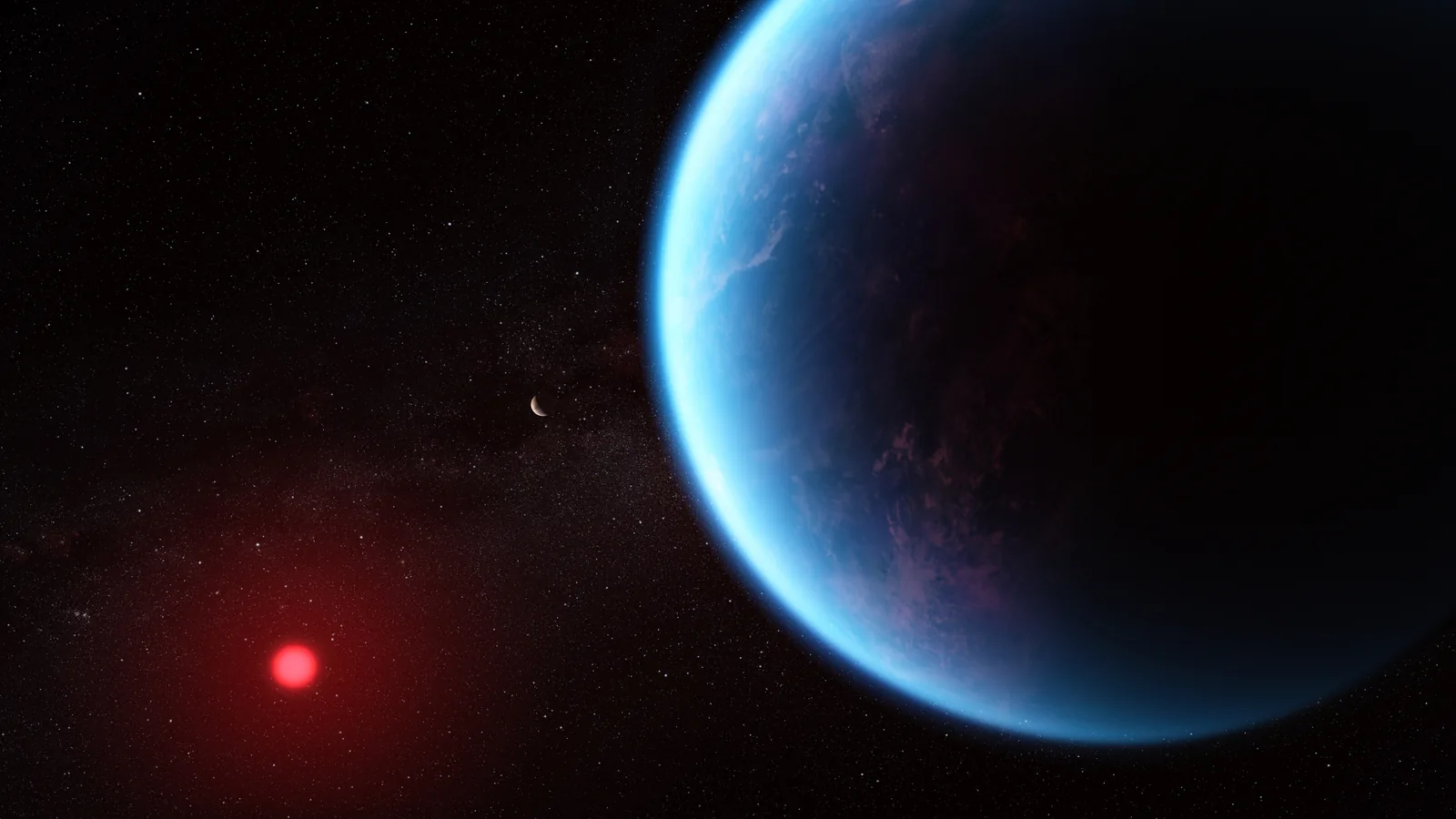
A red dwarf whose planet K2-18 b, a sub-Neptune in the habitable zone, has been studied by JWST.
Measured
- Distance
- 124 light-years
- Constellation
- Leo
- Position (J2000)
- RA 11h 30m 14s, Dec +7.59°
How far, from the Sun
124 light-years. To cross it:
- Light124 years
- Voyager 1's speed2.21 million years
- Driving at 100 km/h1.34 billion years
Voyager 1 at the speed it moved outward over the year to 2026-10-25 (JPL Horizons). Driving: nonstop, never refuelling.
Facts
- K2-18 b is about 8.9 times Earth's mass per the NASA Exoplanet Archive as of October 2026 (other measurements go down to 7.2), and orbits in its star's habitable zone.
- JWST detected methane in 2023 and also reported carbon dioxide. A 2025 reanalysis confirmed the methane but not the CO2; a 2025 preprint on newer JWST data detects both.
- Claims of a possible biosignature gas there are disputed and unconfirmed.
Where this comes from
- Gaia DR3 parallax 26.2469 ± 0.0266 mas, Gaia DR3 3910747531814692736 (Gaia Collaboration 2023, A&A 674, A1)
Every catalogue Ouranos draws is credited on the credits page.