Planetary nebula
The Helix Nebula
Also NGC 7293 · Caldwell 63
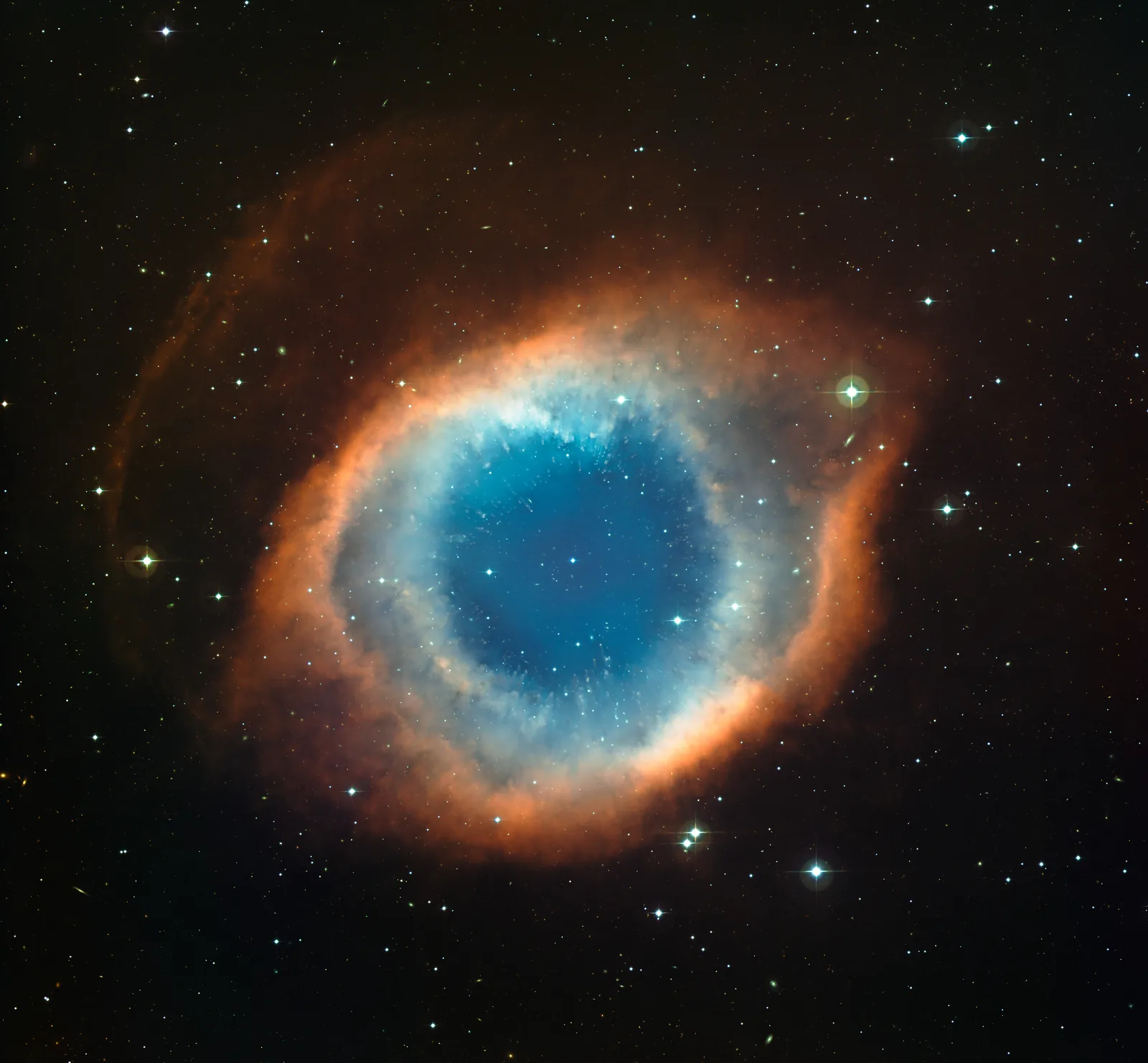
One of the nearest planetary nebulae, the glowing outer layers of a dying star, sometimes called the Eye of God.
Measured
- Distance
- about 650 light-years (published estimates 647–653)
- Size
- about 5.74 light-years across (approximate)
- Constellation
- Aquarius
- Position (J2000)
- RA 22h 29m 38s, Dec −20.84°
How far, from the Sun
About 650 light-years. To cross it:
- Light650 years
- Voyager 1's speed11.6 million years
- Driving at 100 km/h7.02 billion years
Voyager 1 at the speed it moved outward over the year to 2026-10-25 (JPL Horizons). Driving: nonstop, never refuelling.
Facts
- At about 650 light years it is one of the nearest known planetary nebulae to Earth.
- Its bright rings appear nearly half the width of the full Moon; fainter structures reach about 25 arcminutes.
- It holds thousands of comet-shaped gas knots, each with a head wider than our Solar System.
How it was found
- Karl Ludwig Harding discovered it before 1824.
Where this comes from
- Gaia DR3 parallax of the central star, 5.0124 ± 0.0437 mas (Gaia Collaboration 2023, A&A 674, A1)
Every catalogue Ouranos draws is credited on the credits page.