Black hole
Cygnus X-1
Also HDE 226868 · V1357 Cyg
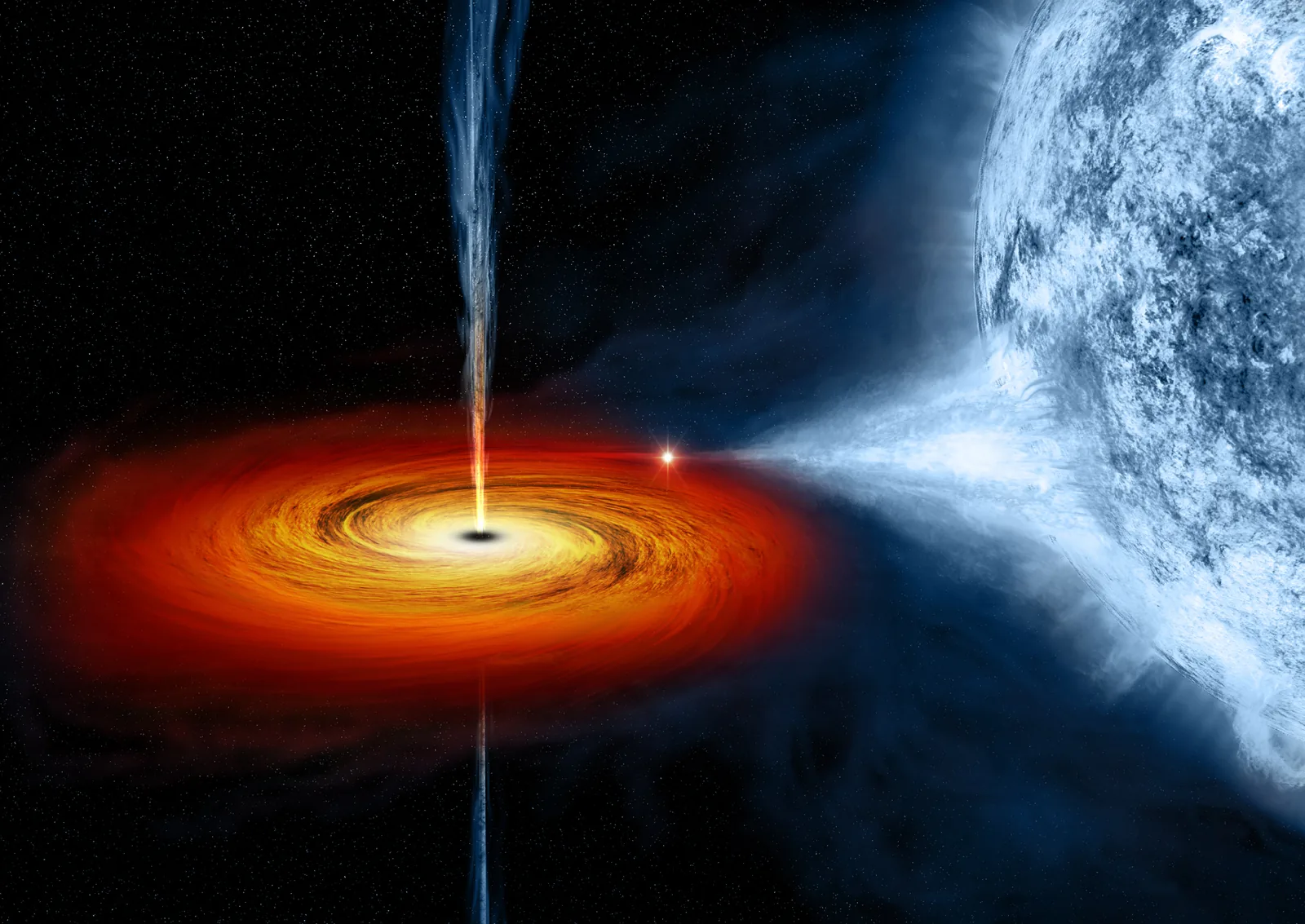
A black hole feeding on a blue supergiant star, the first X-ray source identified as a stellar-mass black hole.
Measured
- Distance
- about 7,240 light-years (published estimates 6,690–7,830)
- Constellation
- Cygnus
- Position (J2000)
- RA 19h 58m 22s, Dec +35.20°
How far, from the Sun
About 7,240 light-years. To cross it:
- Light7,240 years
- Voyager 1's speed129 million years
- Driving at 100 km/h78.1 billion years
Voyager 1 at the speed it moved outward over the year to 2026-10-25 (JPL Horizons). Driving: nonstop, never refuelling.
Facts
- Stephen Hawking bet Kip Thorne in 1974 that it was not a black hole, and conceded in 1990.
- Published estimates of its mass range from about 13 to 21 times the Sun's.
How it was found
- It was discovered in 1964 by X-ray detectors on a suborbital rocket.
Where this comes from
- Miller-Jones et al. 2021, VLBA radio parallax (2.22 +0.18/−0.17 kpc)
Every catalogue Ouranos draws is credited on the credits page.