Supernova remnant
Cassiopeia A
Also Cas A · 3C 461 · SNR G111.7-02.1
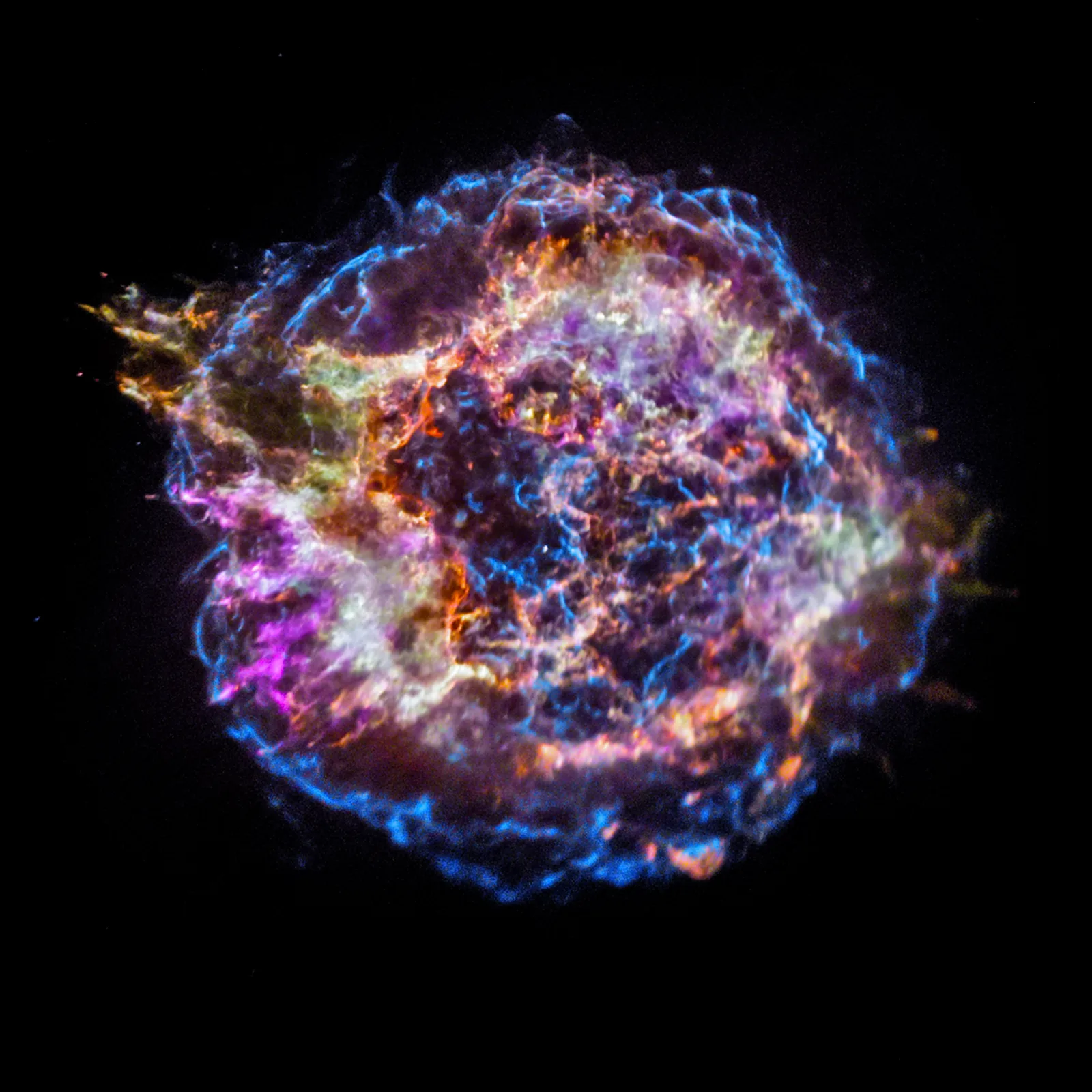
The expanding debris of a massive star whose explosion light reached Earth around 1680.
Measured
- Distance
- about 11,000 light-years (published estimates 10,800–12,100)
- Size
- about 16 light-years across (approximate)
- Constellation
- Cassiopeia
- Position (J2000)
- RA 23h 23m 26s, Dec +58.81°
How far, from the Sun
About 11,000 light-years. To cross it:
- Light11,000 years
- Voyager 1's speed195 million years
- Driving at 100 km/h119 billion years
Voyager 1 at the speed it moved outward over the year to 2026-10-25 (JPL Horizons). Driving: nonstop, never refuelling.
Facts
- Its expansion dates the explosion, as seen from Earth, to about 1681, give or take 19 years.
- No clear historical record of the supernova survives, perhaps because dust dimmed it.
- It is the brightest radio source in the sky beyond the Solar System at frequencies above 1 GHz.
- The Chandra X-ray telescope spotted its central compact source, a neutron star, in its first-light image in 1999.
Where this comes from
- Reed et al. 1995 (3.4 +0.3/−0.1 kpc); expansion age from Fesen et al. 2006
Every catalogue Ouranos draws is credited on the credits page.