Emission nebula
Barnard's Loop
Also Sh 2-276
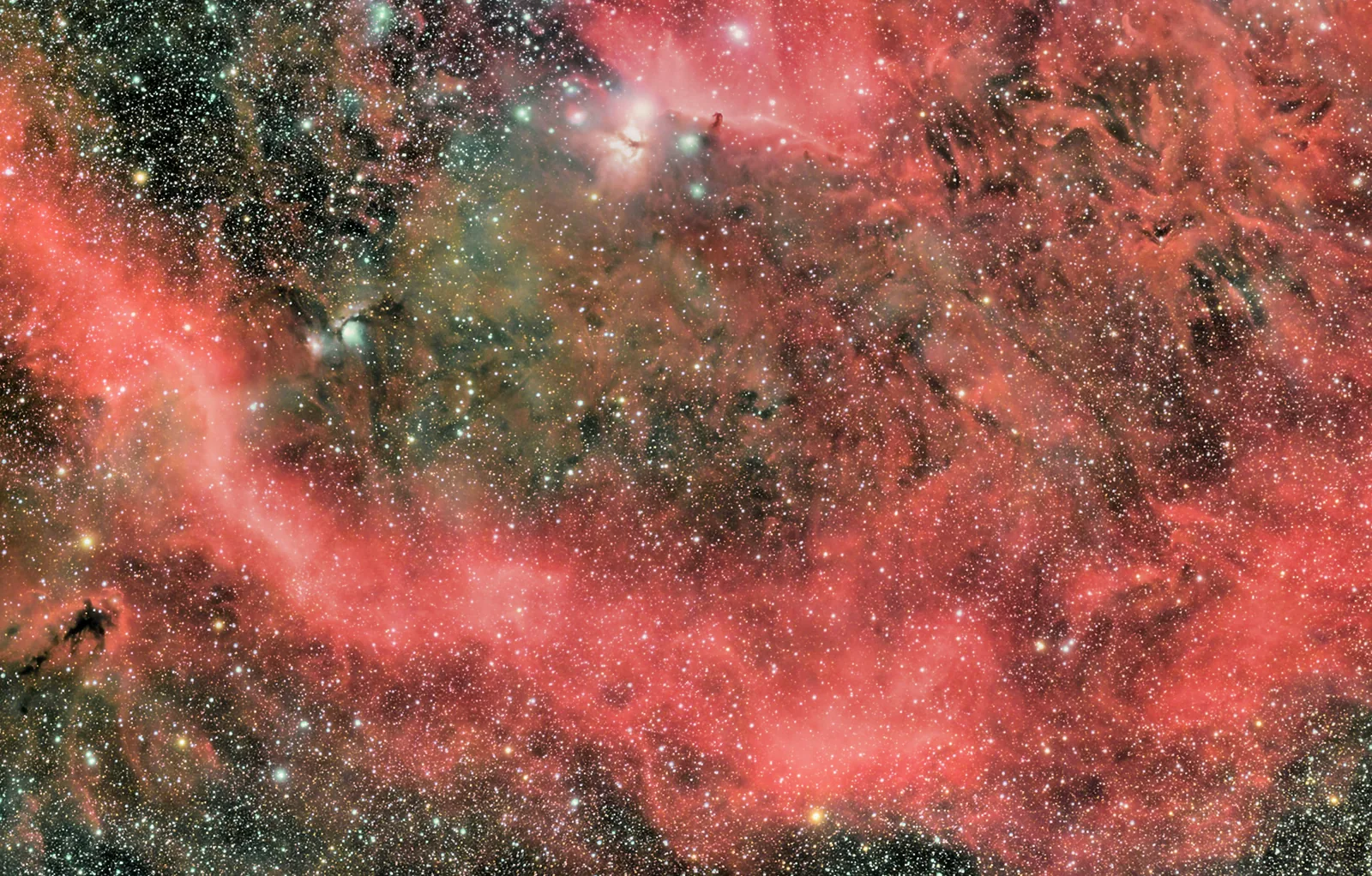
A huge, faint arc of glowing hydrogen that curves around Orion's belt and sword.
Measured
- Distance
- about 1,434 light-years (published estimates 518–1,434)
- Size
- about 300 light-years across (approximate)
- Constellation
- Orion
- Position (J2000)
- RA 5h 27m 30s, Dec −3.97°
How far, from the Sun
About 1,430 light-years. To cross it:
- Light1,430 years
- Voyager 1's speed25.5 million years
- Driving at 100 km/h15.5 billion years
Voyager 1 at the speed it moved outward over the year to 2026-10-25 (JPL Horizons). Driving: nonstop, never refuelling.
Facts
- It is an arc about 14 degrees long, the width of about 28 full Moons.
- It is thought to be a bubble blown by supernovae and winds from Orion's massive stars.
- Its distance is uncertain; studies usually place it near the Orion Nebula, about 1,300 to 1,400 light years away.
How it was found
- It is named for E. E. Barnard, who photographed it in 1894; W. H. Pickering had recorded it in 1889.
Where this comes from
- O'Dell et al. 2011, ApJ 733, 9 (440 pc)
Every catalogue Ouranos draws is credited on the credits page.